Saturday 30th of September, Edinburgh Printmakers opened their latest exhibition which addresses key central themes ranging from political, socio-economic to interpersonal relationships between Scotland and India. From Where I Stand beautifully intertwines oral stories and narratives regarding decolonisation through the historic traditional method of printmaking.
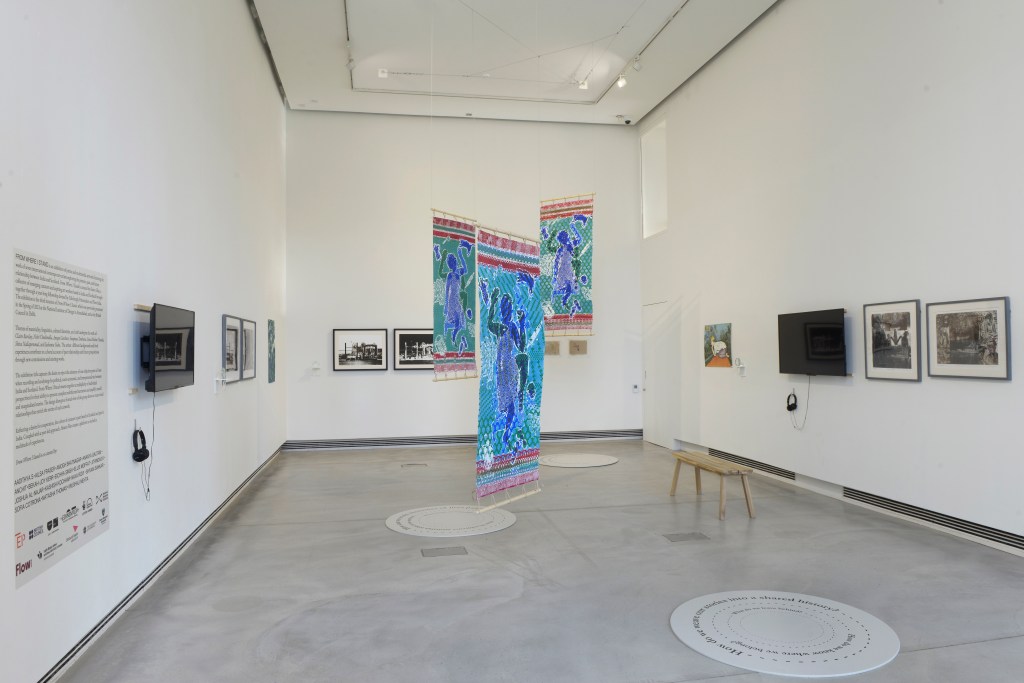
Edinburgh Printmakers partnered with Flow India to co-produce the Future Flow Fellowship programme, which welcomed 20 emerging curators from both India and Scotland. The fellowship accepted applicants of the ages 25 and under to assist with the essential bridging between education and working within the industry. The selected curators were provided the environment to produce and experiment within a professional setting offering crucial experience. The fellowship group seized the opportunity to invite 7 national and international artists, some more familiar and others emerging themselves.
CEO Janet Archer said:
“Future Flow has been an exciting learning opportunity for young adults interested in curating and producing art exhibitions, supported by established professionals working in the visual arts, printmaking and cultural management.
In a world that is changing rapidly, this is an important moment for a global conversation inspired and led by young people. Future Flow addressed issues around environmental sustainability, diversity and inclusion as the Fellows developed their curatorial vision for this exhibition. From Where I Stand explores the intersection of arts and heritage in times of change, starting from the premise that to influence our future, we need to comprehend our present, and understand our past.”
Upon our arrival to the gallery, we were kindly welcomed by Chef Executive, Janet Archer, and Head of Marketing and Engagement, Roseanne Tye, who showed us to the first room. Initially noticing the interactions of each artwork on display, capturing the multifaceted elements of adroit printmaking used to communicate the feeling of home, connection, and identity.
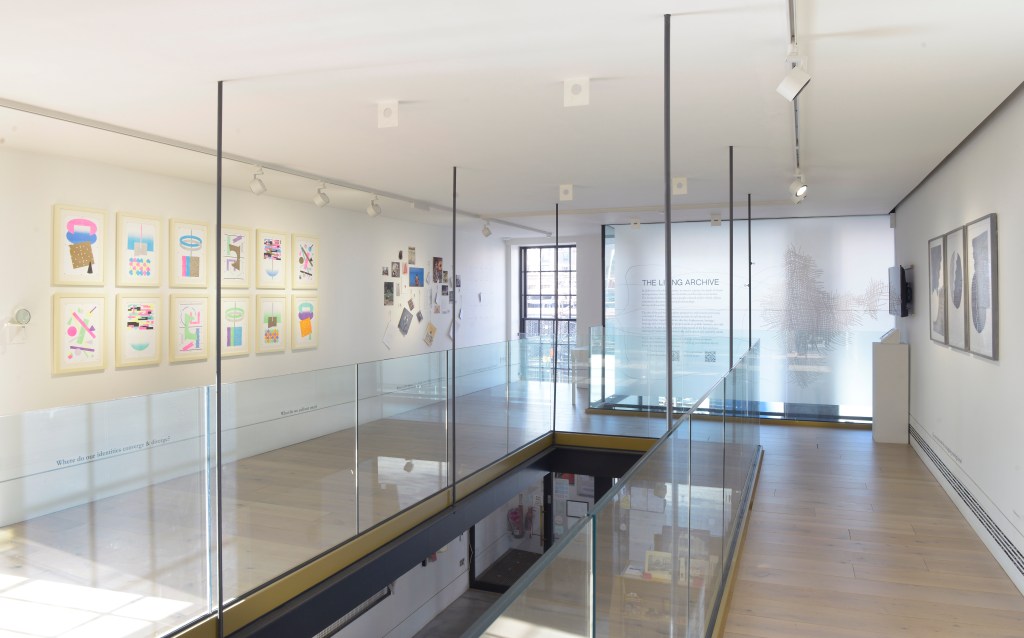
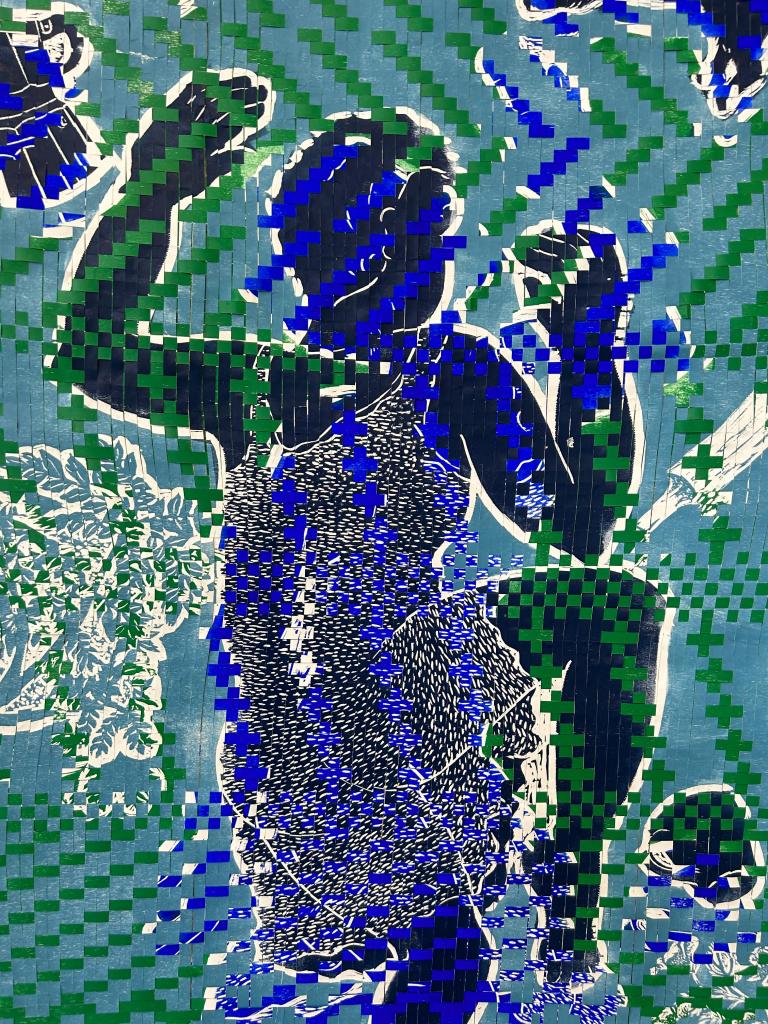
We were introduced to two of the fellows, co-curator Vrushali Mehta, selected from the Indian cohort who has been working alongside EP, and Sofia Cotrona. As we were guided through the exhibition with notes of curatorial decisions which enables a conversation between artworks in the space – it was hard to ignore Anupa Gardner’s suspended works, ‘In Between’. They are colourful woodcut prints which were handwoven to imitate mats. The mats are reminiscent of ‘paai’, a South Indian grass mat that would be found on the floors of homes in India, Gardner’s included. ‘In Between’ gives warmth to the surrounding artworks, situated in the centre of the space. Perhaps an invitation to get comfortable and spend time exploring the patterns and colours within the piece whilst being drawn to correlating textures, colours, and patterns on the outer walls of the space. As we delved deeper into the exhibition, we could see the depth and passion behind the voices of both the artworks and the curatorial fellows. There is a lot to learn from the boundaries between communities, home life, the colourful depiction of India as well as histories of occupation and colonialism.

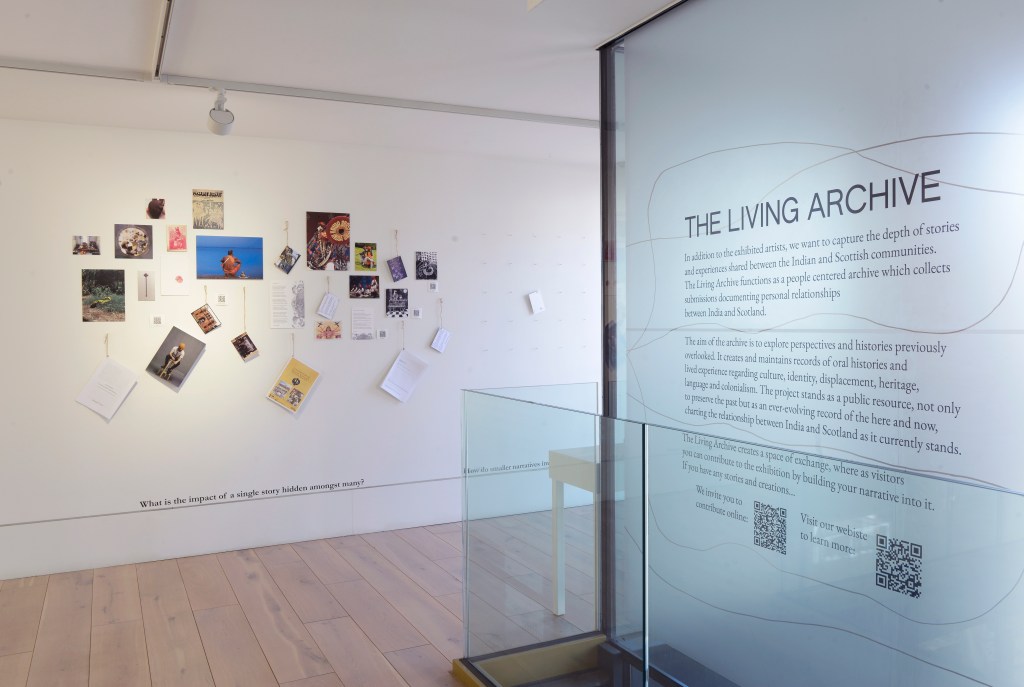
The highlight of this practice and space given is hope for young people to have their say in shaping and platforming histories that are often transient in captured materialistic senses of ‘archive’. Shaping and forging how these histories and folkloric tales are captured in efforts to preserve the long relationship between Scotland and India, recording past and present materials of heritage, language, displacement, and colonialism.
The ‘Living Archive’ that runs alongside the exhibition has become a space to collect submissions from individuals in hopes of creating a community-focused archive. With text, artwork, and photographs – the archive will continue the legacy built during this fellowship and is currently readily available for new submissions. We recommend visiting the archive and discovering more captured moments and cultural stories from around the world that have contributed to safeguarding this future space between Scotland and India.
The Gallery Bagging team prompted each other to describe the work or works that spoke to them most:
Eliza: I know when we first entered the space you were particularly drawn to Nishi Chodimella’s ‘Rangoli’ piece and upstairs Claire Barclay’s ‘Skip Set’ – why do you think this was? They are both visually different pieces but intrigued you the most.
A-J: Immediately I was drawn to Nishi Chodimella’s work – ‘Rangoli’ in particular. At the window sat two dishes with decorative tartan designs made from a powder-like texture accompanied by a rectangular board with an illustration of Scotland neighbouring the country of India. Upon first impressions and associations I naively assumed that both dishes displayed two different tartan designs but was informed by Janet Archer and fellow Vrushali Mehta of my slight misassumption. The dish to the right did contain a tartan pattern, however the identical container to the left displayed a Madras pattern. Archer and Mehta regaled us in the origin of Madras which is an Indian fabric embellished with the tartan-like design stemming from the 1700s trading period between India and the UK.
There’s something about a connection like that which inspires me, makes my brain revel in the inheritance of this knowledge, my body feels excited as that connective tie bonds my soul closer to Chodimella’s work and storytelling.
Claire Barclay’s ‘Skip Set’ which consisted of 3 framed panels depicting shapes with lock and key features. Cotrona eloquently described Barclay’s sourcing of textures from the Edinburgh Printmaker’s own impressive print studio. Our hosts allowed me to express my reading of the works and how they told a story that could be loosely translated from the shapes.
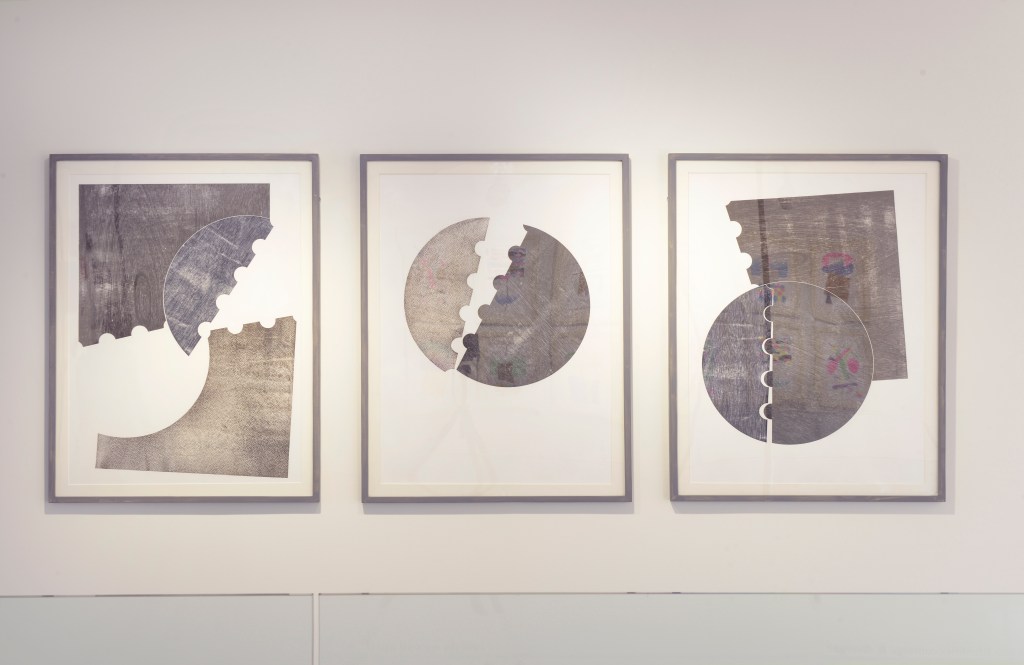
The print farthest to the left included 3 shapes, all different in texture and shade variation – none of them were combined with the lock and key features they were designed with. The print in the middle consisted of two half spherical shapes beginning to use their locking ability but weren’t quite fitting. The final print, farthest to the right, had two half spheres with different shades in variation and textures locked together – these shapes were overshadowed by the larger and darker geometric shape looming over the locked pieces.
This storytelling could be adapted to many metaphors and understandings; I read it as a representation of the combination of different people coming together. The first panel being the separate entities whether it is a result of first meetings or historical caused divide. The second panel a means of trying to understand or being forced into co-operation. The final panel displays a perfect combining which may imply a bond being formed physically and/or spiritually – but in the background looms over a force that may be suggested as issues that still need addressed.
It is described that the works are to represent mechanical shapes, but I enjoy the transferable properties these ambiguous shapes deliver. Cotrona was extremely informative about Barclay’s sourcing of textures from the Edinburgh Printmaker’s own impressive print studio.
A-J: We enjoyed the tour around From Where I Stand, and it was clear to see you were drawn to many of the artworks, in particular Sonia’s. Could you describe what made her work stand out to you?
Eliza: That is a hard one, with so many fabulous pieces that show case a great range of printmaking technical skills and narrative… but I will say I am hugely excited to be writing about an exhibition featuring Sonia Mahra Chawla. I have been a great fan since researching her when I worked for Climate House, The Royal Botanic Garden, Edinburgh last year. The blurring of boundaries between art and science, has been a personal interest of mine. Our more-than-human world needs us more than ever and through art and the fascination of communicating science through art is incredibly important, especially when engaging people in the subject of environments, ecology and the wonderments of the world we live with. Mehra Chawla’s work platforms marginalised communities, farming, fishing, tribal and indigenous people of India and focuses on our entanglements with non-human folk and our intersections in various scopes of environment. Within this exhibition From Where I Stand, Mehra Chawla exhibited ‘Vital to Life’, 2020-22 a video piece, 16 minutes long, of microscopic still images of marine microorganisms.
Visualising the invisible marine microorganisms from the North Sea and Atlantic Ocean, we get a glimpse of an unknown world. Highlighting further that nature is so much more complex than we could ever comprehend. Even imagining the role in which these tiny living beings play in the eco-system, in which goes unnoticed every day, begins to blow the mind. Now with face a climate catastrophe – ecosystem in distress, and for me, this work gives these microorganisms a space to be seen. Placing this work in this context helps to focus our attention towards a view that dismantles anthropogenic existence at the top of all other living beings and dismantles Westernisation that contributes to damaging and exploitative practices. Mehra Chawla reveals to us that nature is very much symbiotic, kinships are formed in the underworld that keeps this planet going. A lesson to learn from.
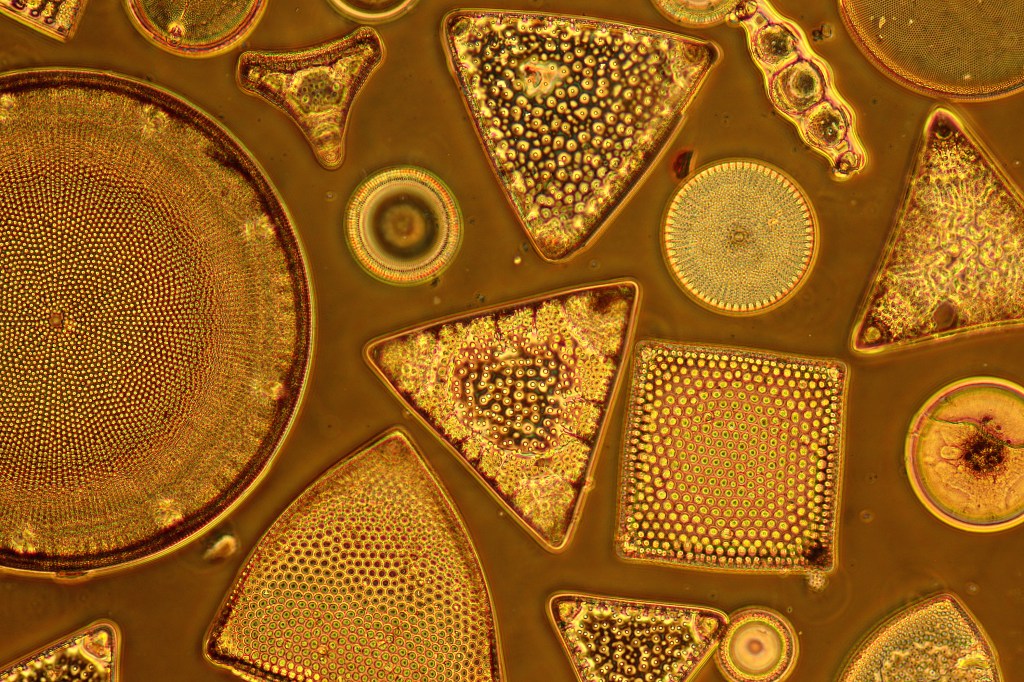
The piece of work also showcases the beauty and intricacy of the organisms that cannot be seen by the human eye. It makes me believe that not all beauty is to be viewed by humans – there is something special to think that there are untouched aspects of nature that we will never have the privilege of seeing and perhaps in this thought we de-centre the human omnipotence.
From this small organism, not such a small response is triggered. Perhaps they make a bigger impact on our every day, visible or not, that I originally thought. Thank you, Sonia Mehra Chawla, for highlighting these important beings.
As we near the end of this review, we wanted to outline questions that we feel that the exhibition prompts the viewer to think:
‘How do we weave our stories into a shared history?’
‘How can we retain memories of lives past?’
‘Whose stories are remembered?’
Overall, Gallery Bagging had an excellent and insightful experience at Edinburgh Printmakers, and it was a pleasure to meet the two fellows Vrushali Mehta and Sofia Cotrona, Janet Archer and Roseanne Tye.
From Where I Stand is open to view until the 3rd of December 2023 and Edinburgh Printmakers is complete with a café providing a place for reflection regarding the artworks and appreciation of Future Flow’s mission.
Future Flow 2022 Fellows
Aadithya S · Ailsa Fraser · Amogh Bhatnagar · Ananya Gautam · Anchit · Bekah-Joy Kerr · Eichha Singh · Ellie Moffat · Ezra Berrnicio · Jithindas K · Joshua Al-Najar · Kashish Kochhar · Nava Rizvi · Sofia Cotrona · Shivani Sankar · Natasha Thomas · Vrushali Mehta
Future Flow Contributing Artists
Shiva Nallaperumal · Sonia Mehra Chawla · Claire Barclay · Nishi Chodimella · Sushanta Guha · Anupa Gardner · Swapnaa Tamhane
The project and exhibitions have been supported by The British Council.
The project was conceived as part of the British Council’s India/UK Together, a Season of Culture, which marked the deep connections and 75th anniversary of India with a landmark programme that strengthened the friendship and vibrant cultural bonds of both countries, while addressing shared global challenges.
To find out more head to: https://edinburghprintmakers.co.uk/futureflow/
And to access the Living Archive visit: https://edinburghprintmakers.co.uk/the-living-archive
Review written as a collaboration between A-J and Eliza
 Gal bag.