A hidden gem, with a rich history and a diverse collection that continues to grow, the Pathfoot Art Collection at the University of Stirling is certainly an interesting art hub. Mixing academia with art, 60s architecture with outside sculptural curation, modern with contemporary, I was thrilled to delve into this space further with Deputy of University Collections Emma McCombie.
What struck me most about my meeting with Emma, was the history of the building and the role this plays in the response to new exhibitions as well as the preservation of the collection. There is a great passion and knowledge of the building in which the ethos of the ‘gallery’ space propels the future of Pathfoot.

Through this meeting, I continued to learn of the history of Pathfoot and the strive to collect art since the day of its inception in 1967. Working alongside the original purpose envisioned by the University’s first Principal, Dr Tom Cottrell (1967-1973), it was decided this building with its collection of artworks would improve the inside and outside environments thus creating well rounded students, both in academia and in the arts. Emma told me, that even to this day the extensive growing collection and exhibitions are amongst students studying a vast array of subjects, reaching beyond the arts into everyday life. The idea the art sits in the domesticity of the building, to be ‘grazed’ upon.
The collection holds a major print collection, including work by Norman Ackroyd, Robyn Denny, Terry Frost, John Hoyland, Willie Rodger, Elizabeth Frink, Patrick Caulfield, Pierre Celice, Ian Hamilton Finlay, David Imms, John Brunsdon, Graham Sutherland.
Recently the collection has focused exclusively on Scottish contemporary art, and the collection now includes works by: Calum Colvin, Brigid Collins, Adrian Wiszniewski, Sandy Moffat, Philip Braham, Alan Davie, Wilhelmina Barns Graham, Lotte Glob, Alan Davie, Lys Hansen, Helen Denerley and Kate Downie.
With one of its first major collected sculpture ‘Figure (Archaean)’ by Barbara Hepworth DBE (Bronze, 1/7, 1959).
(kindly loaned by Maggie Inall in memory of her husband,
Dr. Inall, a surgeon at Stirling Royal Infirmary). and 3: scrap metal Oyster Catcher by Helen Denerley.
Image by Eliza Coulson
There is a real sense of collaboration between the building’s design and the collection which feels very much apart of the fabric of the spaces it inhabits. With courtyards and vast amounts of natural light, this building is a keen example of 1960s architecture, merging with the surrounding landscape. Today, the curation of the artworks continue to mirror the inside and outside concept and the courtyards dotted around proving this still.
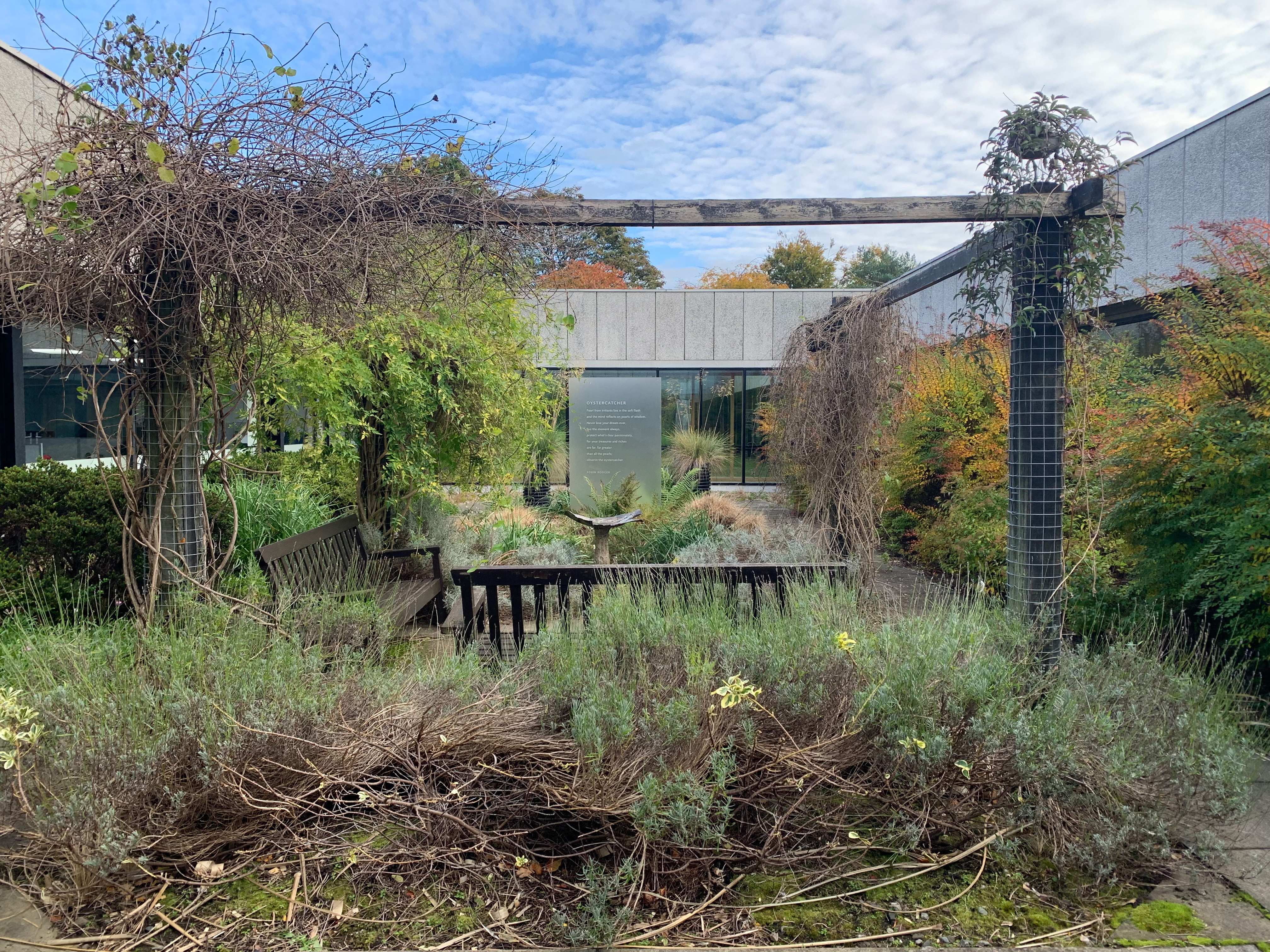
I was amazed when Emma told me the curation involved in each courtyard, and the aim for these spaces to become sculpture parks in themselves. The courtyard pictured above has a wonderful history of this collaboration and curation. Designed in tandem with a major Willie Rodger exhibition in 2007 it was decided this adjacent courtyard to the exhibition would be overhauled, two of Rodger’s sons would be involved in the remaking of this space. Including specific wheel chair access, and sculptures relating to the frequent nesting pairs of Oystercatchers that make their home in this courtyard. Hidden at the top right (above image) amongst the shrubbery is a scrap metal Oystercatcher by Helen Denerly, centred is ceramic birdbath by Lottie Glob and at the back is glass panel with the Oystercatcher poem by Rodger’s son, Robin Rodger.
To this day these spaces continue to flourish by working specifically with the gardener to plant according to the surrounding sculptures, creating a conversation between the plants and sculptures. For example, in one of the other courtyards, a bronze sculpture of Adam and Eve stands shaded by an apple tree. I love this conversation with nature and art, and how the students are free to roam amongst the art and experience these beautiful quiet spaces, or not quiet spaces, as Emma often sees students conversing especially in the sunnier days. I bet this enables the artworks to come alive.
With this in mind what better way to honour the collection than with current exhibition ‘Interior Dialogues’ with contemporary artist Christine Borland.
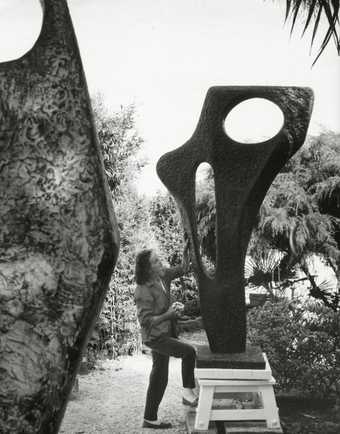
Working thematically, Pathfoot presents a celebration of the collection in which has inspired creativity in various ways. ‘Inspired’ this years theme of exhibitions in Pathfoot really sets the precedent for the permanent collection. Being inspired by prolific modern artist Barbara Hepworth, Borland seeks to create a response to the long held emotional and intellectual connection with Hepworth, looking closely at Oval Sculpture (1943). Interior Dialogues can be found in the foyer known as ’Gallery One’, the exhibition highlights the invisible interior making them visible.

Oval Interiors is an impressive negative of Barbara Hepworth’s Oval Sculpture; the bronze sculpture may be a continuation from Borland’s Positive Pattern (2007) exhibition. The 2007 exhibition was commissioned by The Institute of Transplantation in Newcastle as a gesture of appreciation to organ donors and their families for their honourable acts of kindness. Hepworth also drew on the importance of human connection making her work apt as this exhibition’s source of inspiration. This piece feels almost reflective of this human response with its organic formation.
Barbara Hepworth (1903 – 1975) was born in Yorkshire, studied at Leeds School of Art as well as the Royal College of Art, London. Her base of operations was at the Cornish Coast, Cornwall, where she worked on sculptures that were inspired directly by her home: the waves that crashed against the rocks as well as other natural forms. Christine Borland also draws from nature and goes by the ethos of drawing not what she sees but how her body feels.
The pair’s works, ethos and inspirations complement Pathfoot’s ambitions concerning nature and art dialect.
“The series of pierced oval sculpture, made by Hepworth in the mid-1940s is often described with reference to the land and seascapes of her home on the Cornish coast, while these artworks evoke human and post-human themes which echo the physical intimacy of Hepworth’s Hospital Drawings, made in the same period.” (quote from exhibition text).
Positioned in front of the foyer’s window looking onto a nestled courtyard host to Hepworth’s sculpture Figure (1959) Borland’s works speaks to Hepworth, an honouring of the work with a bronzed patina finish for correlation.
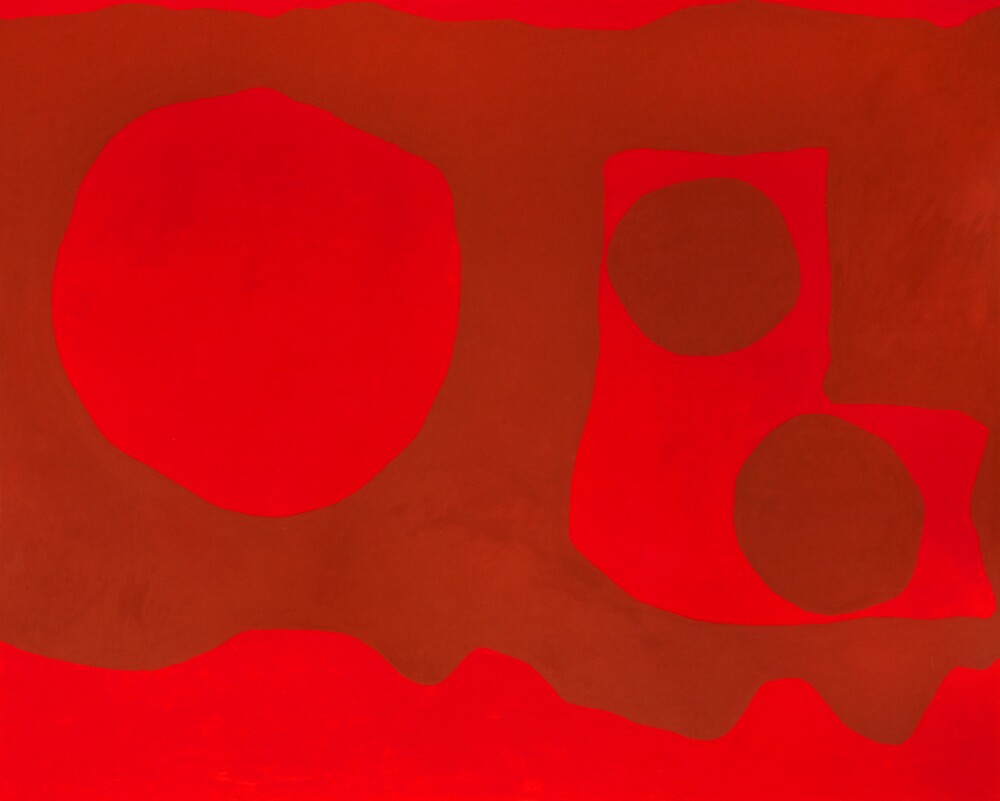
There is such a vast amount of work on display, not only in Gallery One but Gallery Two with ‘Campus Inspired’ show casing artistic responses to the experience of being at Stirling. Featuring dance, sound and photography, representing ways that artists the have been creatively inspired by the University buildings and campus life. In the ‘Crush Hall’ a curated display of paintings and prints from the collection, inspired by a single painting (above): ‘Cadmium and Light Red’ by Patrick Heron. Basing the rest of the curation against the bold red’s the ‘Crush Hall’ exhibition is bursting with collection prints full of red, maroon to crimson. Gallery 3 & 4 features collected work by printmaker Willie Rodger in ‘The Art of Willie Rodger.’ So much to pack in, it couldn’t all be written.
We do highly recommend visiting and checking out the interesting things this art collection are doing on the door step of Stirling, Edinburgh, Glasgow and Dundee.
Emma shares with me the depth of community engagement undertaken by the Pathfoot team; ‘Unpacked: Home from Home’, a collaboration between the University Art Collection, artist Brigid Collins, women who fled Syria who are now settled in Falkirk and Stirling, and students of the Creative Writing MLitt at Stirling. ArtReach, a project in collaboration with ArtLink, is an annual summer school for adults with learning difficulties, and ArtSpace which is a group of adults with mental health issues. The diverse levels in which they are expanding the ways in which the collection is responded also featuring an Artist Residency, with current artist is residency Audrey Grant, award-winning painter whose practice includes drawing, photography, and site-specific installation. Grant’s work is underpinned by intellectual ideas derived from, and inspired by, poetry, literature, and philosophy.
‘Audrey’s inspiration within the Art Collection theme of the year 2023/2024 ‘Campus as Inspiration’, includes ‘found sculptural environment and metaphorical palimpsest of the past, present and future’; ‘as a grounding to cultivate the poetical imagination, and the realms we inhabit indoors, outdoors and within the psyche’ to check out more head to: https://www.stir.ac.uk/about/art-collection/campus-as-inspiration/artists-in-residence/
It was an absolute pleasure to get to know the space more and thank you to Emma who kindly offered to take us around, we hope to keep up to date with Pathfoot and the interesting developments happening there.
Christine Borland was born in Darvel, Ayrshire and studied at Glasgow School of Art and the University of Ulster, Belfast. Her work has often involved collaboration with non-art related institutions, exploring areas such as forensic science, the history of medicine, medical ethics and human genetics. Borland frequently asks us to consider the fragility of human life and the way in which it is valued by social systems and institutions. She works with a variety of materials, including glass, china, fabric and bronze. Borland was nominated for the Turner Prize in 1997. Recent solo shows have included those at Glasgow Sculpture Studios (2010) and Camden Arts Centre, London (2011), and a collaborative project with Brody Condon for Edinburgh Art Festival (2012). Borland is BALTIC Professor at the BxNU Institute of Contemporary Art. She lives and works in Kilcreggan, Argyll.
Interior Dialogue or Oval Interior are now part of the University permanent collection and were purchased with support from the National Fund for Acquisitions
The exhibition Interior Dialogue is on display in Galllery One of the Pathfoot Building at the University until 31st July 2024.
https://www.stir.ac.uk/about/art-collection/
Written by Eliza, contributed with insights and knowledge by A-J.
 Gal bag.