It is 1pm on December 4th and GalBag are in the studio of the interdisciplinary artist Nishi Chodimella. The location is Edinburgh College of Art, to reach the studio space one must access the lobby, gawk and walk through The Sculpture Court, nip through Corridor C30 connecting to Stairwell 6. The incline is breathy and the destination is breathless; the panoramic view of Edinburgh Castle through rain-laced windows fills the mind with architectural poetry.
We begin with an introduction to Nishi’s investigative and experimental practice into the ‘invasive’ riparian Himalayan Balsam plant. Chodimella highlights the plant’s language’s syncrisis with their human counterparts as a metaphor for immigrants, a term that defines those as ‘other’ and ‘alien’.
Complications, like dealing with any non-native fauna, come with the Balsam plant such as the rules and regulations banning the propagation and growing of it. Nishi’s instructed obligation was to remove all sexual organs from the shrubs for the continuation of their artwork – they express that the act of “castrating” the plant was a process further representing this anthropomorphic treatment of our non-living flora-folk. In recognising the destructive affects the Himalayan Balsam plant has on the UK eco-system; we must not forget the plant’s innocence as it was the colonial plant trade that imported these species over. Though, the plant still nurtures prejudices and organised balsam-bashing regardless of this fact.
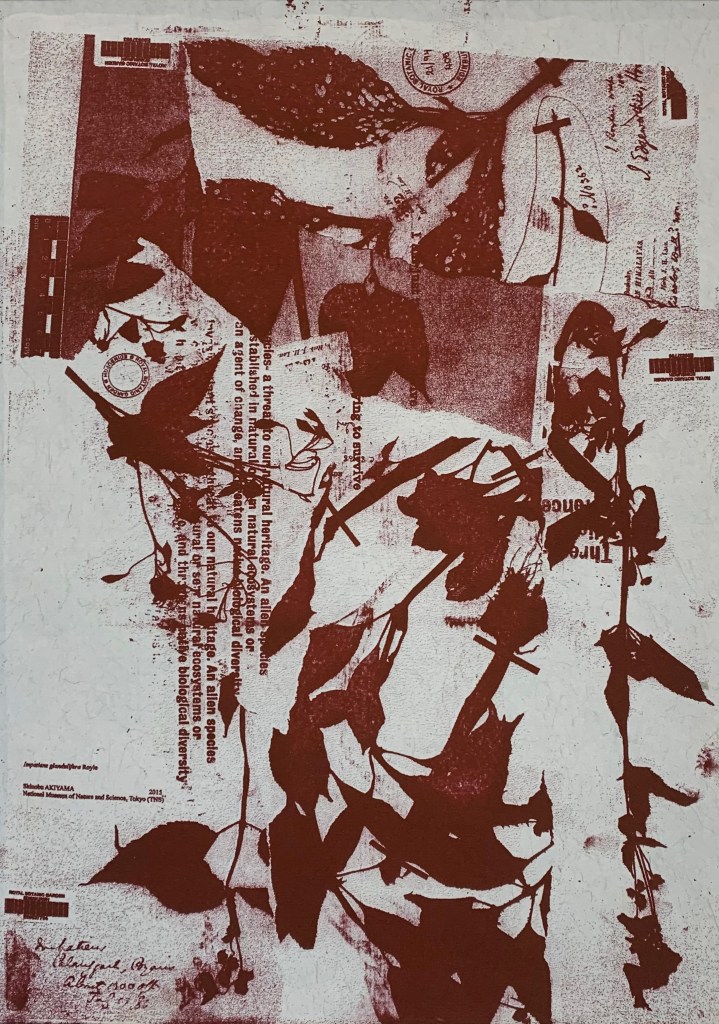
“I am castrating a plant so it can be acceptable, so you think, my practice is drawing parallels about immigration and marginalised communities through plants and the natural environment as an easier way to dip your toes into it without being traumatizing.”
The restrictive nature of the COVID Pandemic enforced Nishi to self-reflect and what they meditated upon ignited the methodology to her practice. They expressed this sudden need to explore her identity of being an Indian citizen who lived in Dubai, but currently staying in Scotland. Informing us on the situation where their tourist-visa was cancelled the night before the flight to Dubai, squashing any efforts to return for the lockdown in order to be with family. Like the plant, Nishi, too, becoming firmly planted within Scotland. Experiencing this strange reality of perhaps accepting Scotland as their new place of residence when Dubai was home for 19 years before moving to study; Nishi has used this experience to generate work and explore themes through the migration and colonialism attached to plants and ecosystems in distress.
This diaspora of identity is recognised with the most recent exhibition Chodimella participated in From Where I Stand (2023) hosted by Edinburgh Printmakers and curated by Future Flow.
“In Nishi Chodimella’s prints, the Himalayan Balsam plant, considered an invasive species, is used to explore capitalise attitudes towards ecosystems.” Caption from Edinburgh Print Maker’s website
As a volunteer at the Royal Botanic Garden in Edinburgh Nishi has access to information and their sources revolving around colonialism, heritage, and invasive species through exhibitions of both art and archival collections. In 2023, the Climate House, on-site at RBGE, launched the exhibition Shipping Roots: A Sensory Journey Exploring Plants on the Move by artist Keg De Souza drawing on the botanic’s collection to tell the story of the eucalyptus, the prickly pear and ‘alien’ seeds. De Souza’s exhibition delineated the link between the British Empire with Australia, India and the UK, as a relation to their Goan heritage and lived experiences. Speaking of ancestral lands that were colonised to now living as a settler on Gadigal land in Sydney.
Shipping Roots was a crucial moment for Nishi in recognising her own ancestral relationship to the Himalayan Balsam with her Indian heritage.

Alberta Whittle is another example of an inspiring artist to Nishi. Outlining their attention to Whittle’s use of vibrant colours to depict the tales and place of her artwork as it portrays identity, institutional racism and climate emergency. Wanting to incorporate this sense of colour as a distraction to more complex topics addressed in the works, Nishi shows her Whittle-palette influenced work (above) whilst sharing her inspiration drawn from a nursery tale published in 1981:
I got if from a children’s illustrated story book called Mr Bill and the Flying Fish, and, so, the story goes that Mr Bill’s brother, Tom, is a sailor and he brought back his nephew a present. It was this little fish tank of four flying fish in a wicker basket and he, just, like, said Here I got you this from the Indian Ocean – these flying fish. And they put them in the bathtub and overnight they multiplied to, like, 100 or something. And Mr Bill said The sooner they go back to the Indian Ocean the better and they escaped and they started terrorising the city and the locals and putting stress on the emergency services, and [the flying fish] were chased back out to the Indian Ocean on a row boat.
Nishi then goes on to describe the characteristics of the flying fish and how they are evocative of “blackface”. She describes the emphasised lips and giddy disposition of the fish, as well as the havoc they created in the town they were brought to by Mr Bill’s brother, reminiscent of the Himalayan Balsam.
Nishi revealed her experimenting with the Balsam plant, sharing with us her research into the properties that can be extracted from the greenery such as dye and oil. She has attempted to make paper from the riparian which she reviewed as a difficult process due to its lack of fibre followed by a length-y drying time of 3 months – we await to see the final product still.
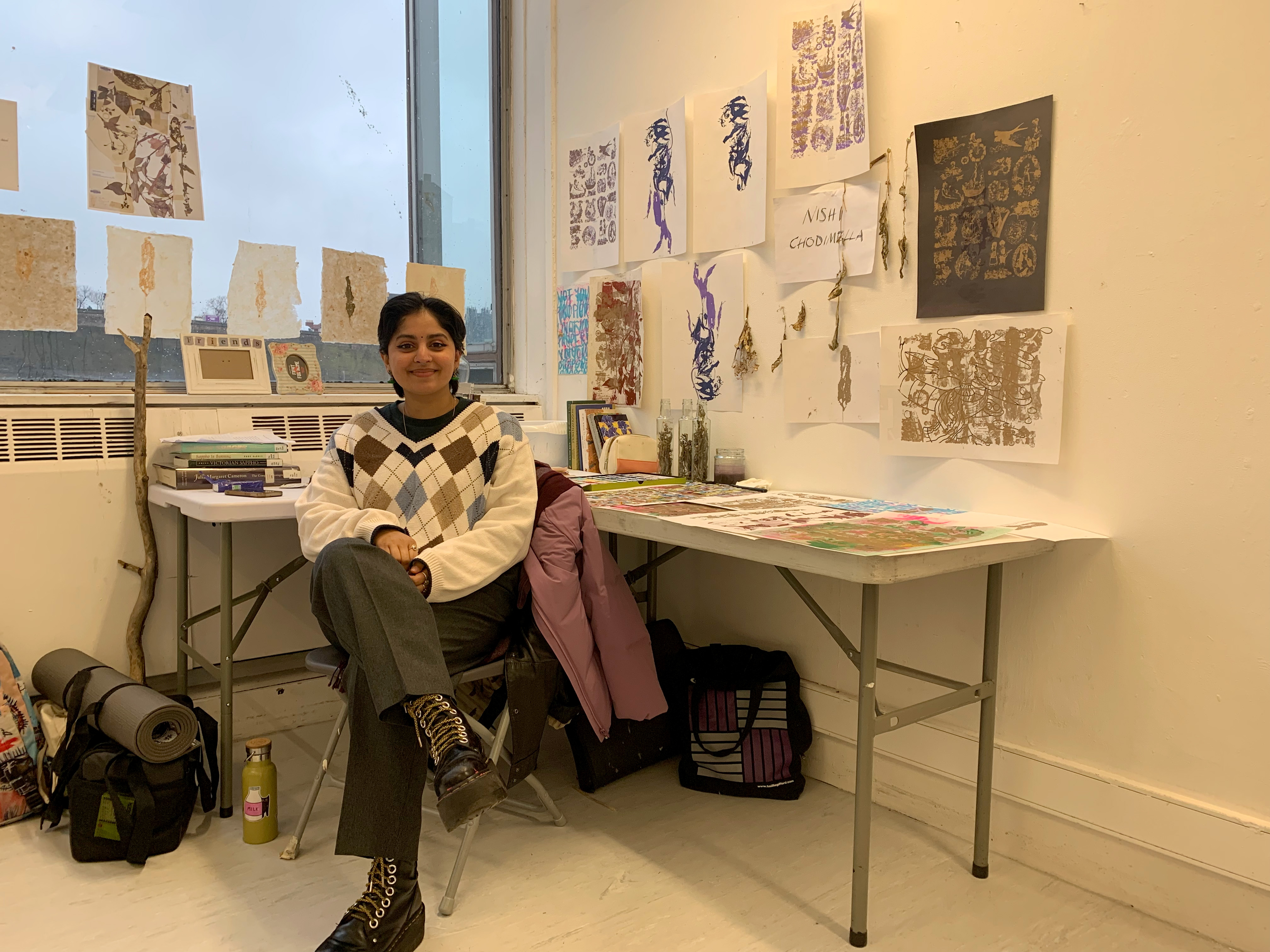
To end our session with Nishi, they introduced us to a game created in an effort to tackle creative blocks using colour swatches, with word(s) scrawled on the back, they are to be picked based on which colours appeal most providing broken poems to help stimulate word play, hopefully generating something more.
Sifting through the pile of swatches, GalBag unintentionally chose together the colours we liked most. The reveal:
Nobody | Lemon Sherbet | Seascape | Isolated Bliss…
___________________________________________
Nishi Chodimella is an interdisciplinary artist currently studying MA Fine Art at Edinburgh College of art specialising in printmaking and papermaking. Nishi was born in India, raised in the United Arab Emirates and has now been living in Scotland for the past four years. Their artistic journey is passionately engaged in creating a unique platform for showcasing artwork that delves into the intricate concept of intersectionality as a decolonial act. Building upon their previous series of prints, which focused on deconstructing language and challenging colonial notions of identity, she is now embarking on a new exploration — one centred on space.
This exploration encompasses both the physical and emotional dimensions of space, and it invites Nishi to delve into the intricate ways in which space can be political and contested. Borders, seas, and oceans all hold their own complex narratives, but what intrigues them most is the often-overlooked fringes and in-between spaces. These areas are frequently left unattended, forgotten, and unkept.
Nishi’s aspiration is to position her artistic practice firmly within these fringes and forgotten spaces, to tend to them and breathe new life into them. Their goal is to create a haven, a safe and nurturing environment, where individuals who also feel that they belong to the in-between spaces can find solace and a sense of belonging. Through art, Nishi seeks to shed light on the beauty and significance of these often-neglected corners of our world and celebrate the diverse narratives that unfold within them.
Instagram: @/nishichodimellaart
https://www.nishichodimella.com/
Thank you to Nishi for being a part of our first Studio Chat.
Written by Eliza and edited by A-J
 Gal bag.