As contemporary art continues to transform into conduits of critically constructed stories and revelations regarding this noticeably ephemeral globe and its inhabitants – art proceeds to creatively transform the elements around us including those that would be considered rare or impossible to obtain. Edinburgh-based ceramicist, Mella Shaw, for Sounding-Line has produced a rare combined medium composed of clay and china-bone made from a beached Northern Bottlenose whale used for highlighting the effect of sonar and sound-pollution and its specific affect on Cetaceans.
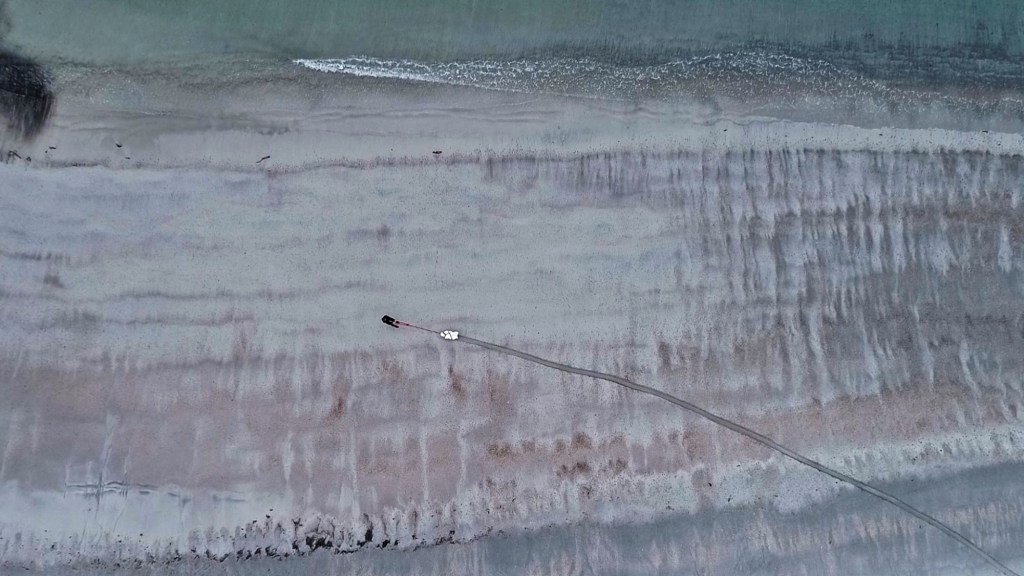
During her talk at Summerhall, Edinburgh, Shaw regaled us with the origin stories of her British Ceramics Biennial award-winning exhibition Sounding Line that covers a 5 year-long period of research, paperwork, and multiple visits to the Hebridean isles. It was at the Hebrides beaches that Shaw discovered the natural beauty of the white and black volcanic sands, but also its macabre position as a whale gravesite.
Half a decade ago, over 100 whales were found beached along the West coast of Scotland and Ireland. More than 45 of these unfortunate Cetaceans were identified as the Cuvier Beaked whales, known for their deep-sea dwelling which hinted towards sonar and sound-pollution being the cause of this mass culling. These loud man-made noises conflict with the whale’s natural ability to use echolocation causing them to rise to the surface at a Bends-incurring rate. The decompression sickness leads to confusion in these creatures which can be fatal. There are multiple sources of sound and sonar produced by humans such as seismic surveyors, ships, pingers, echo sounders and, most upsetting, wind farms.
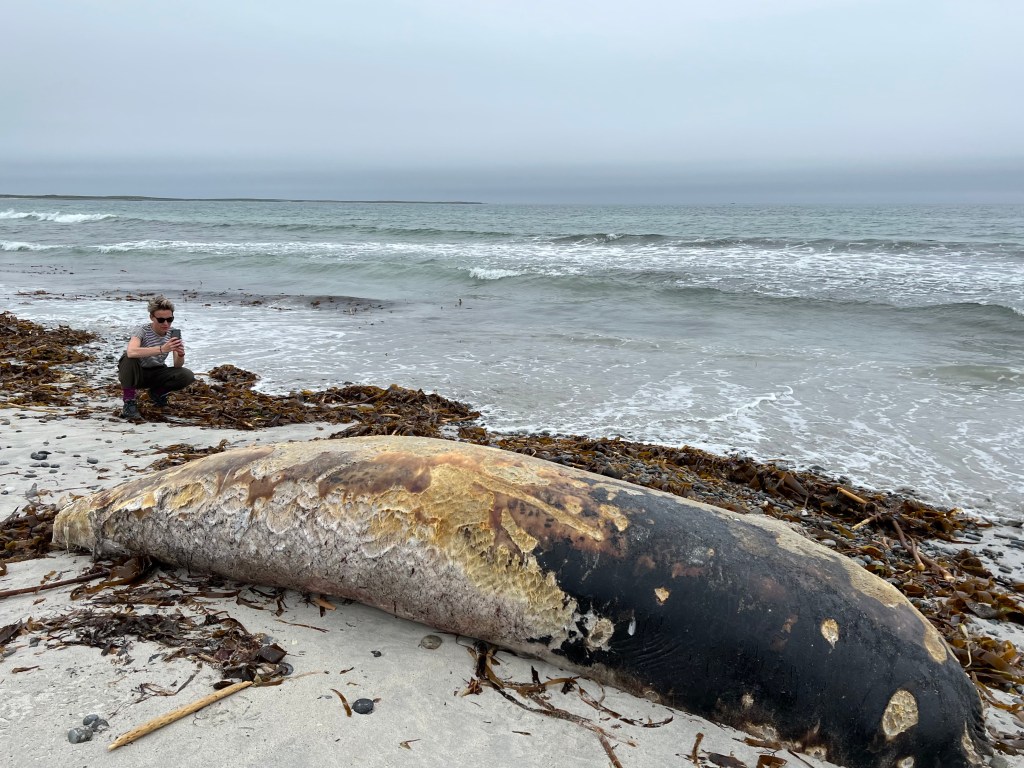
From research to travelling, An Doirlinn beach, South Uist, was a recommended site to explore and it was on this shoreline that Shaw (un)fortunately discovered a rotting Minke whale carcass whose smell, as she described, was so pungent that it has burnt itself into her sensory’s memory. An interesting feature (or lack of) regarding this beached creature was that it was both without a head and tail fin enhancing the “Otherness” of this creature to Shaw. It does not belong on land, yet here it is; it is a large and impressive form, yet here it is; it’s final resting place, not the grave nature intended for it. It is like it was given the option to choose heads or tail(s) but was denied both.
Shaw was able to find both the tail and the head, though, unlike the body of blubber, the head was picked clean of its meaty membrane leaving an immaculate skull. An image of the skull can be viewed at the Sounding Line exhibition, neighboured by photographs of “Sand Etchings”, as Shaw likes to call them. These wide and extremely shallow channels created by small eddies depict a marbled texture consisting of black volcanic sand mixed with white sand, highlighting an abstract beauty and adding to the natural artistry of the land.
Shaw had sourced material and information not only through fieldwork but, also, through inquiries with museums that enabled her to view their collections. This process was key in the envisioning of her work, such as the discovery of the tiny inner-ear bones that inspired the final shapes.
With this structural vision, a material would be needed to actualise the concept and Shaw had a particular medium in mind. As mentioned in the opening of this writing, Shaw had acquired the bones of the protected species known as the Northern Bottlenose whale which was also represented in the mass stranding 5 years ago. This was not a straight-forward process nor a short one as it took 9 months for Nature Scot to grant Shaw permission. Having finally received the bones, she fired and ground them into a fine powder; this process reflects on the whale as one envisions it as a large and magical creature but once afflicted and stranded it becomes weak and fragile. The process continues as the bone-ash is combined with clay. The first half of the sculpture was made upright and the rest was applied through a coil-building technique. Most pieces were fired in kilns with the exception of two that were used for the video shown at the exhibition demonstrating the act of returning the whale to the ocean. This, I feel, was an integral action to carry-out due to the natural roles that whales play in sustaining the depths of the sea.
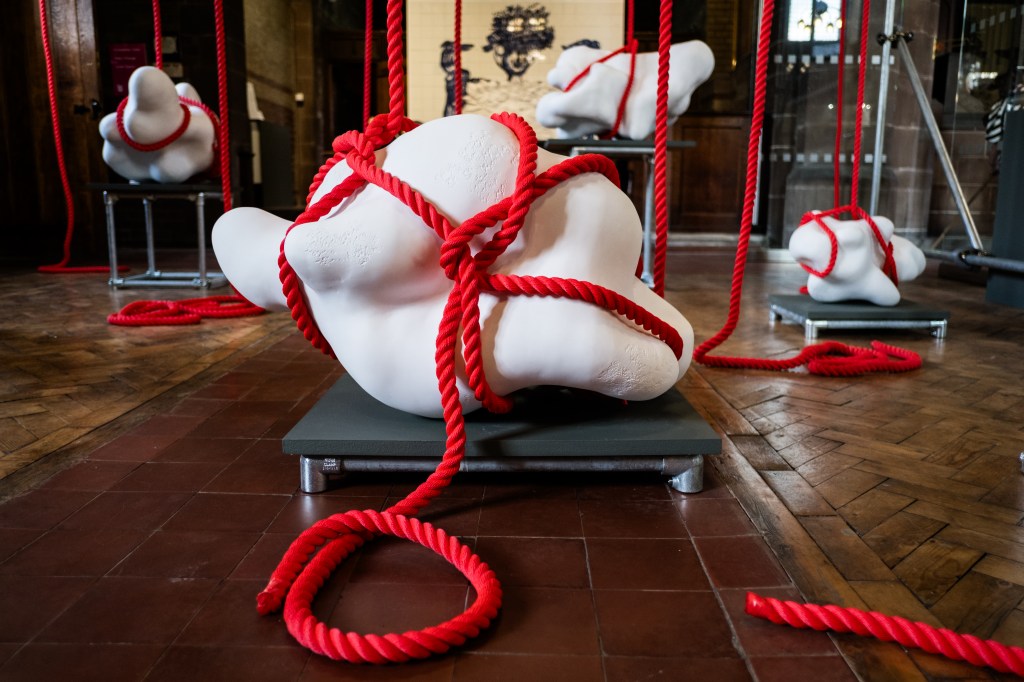
As a way to neatly tie her clay sculptures in a bow, Shaw added the sea-depth measuring rope known as a sounding line, hence the title. These vibrant red marine ropes contrast against the startling white sculptures, like a blood vessel feeding its organ. The sounding line rope not only brings life with colour but also brings life through sensory engagement (thankfully not through the nose-burning kind). Collaborating with artist Theodore Koterwas who was able to resonate the vibrations pulled from a 24 hour recording of sonar and ships condensed into 24 minutes, the public are able to experience and immerse themselves encouraging reflection on this matter.
There is so much to explore and uncover, but what Shaw has done here is proved the communication through art of the environmental impacts of anthropogenic activity on our wildlife. Close to home, this exhibition and body of work has taught me something that is crucial. I couldn’t believe when she revealed Wind Farms’ harmful contributions to marine life, this “solution” that I’ve only known as salvation to our current echo-catastrophe turns out to be a part of another problem. Using art to explore and connect through science, are ways in which we can explore these vital topics.
We highly recommend visiting this exhibition (ASAP) – as well as the other exhibition a part of ‘FORM: A season of exhibitions by female contemporary sculptors’ exhibited at Summerhall.
https://www.summerhallarts.co.uk/event/foreign-objects/
Opening times:
Wednesday – Sunday, 11am – 5pm
1st of December 2023 – 25th of February 2024
Location:
Summerhall, Newington, Edinburgh, EH9 1PL
Website: https://www.mellashaw.co.uk/info/about/
Instagram: @mellamine
Written by A-J Reynolds
 Gal bag.