A 22-minute walk from the Glasgow Queen Street station existed the brief exhibition In the Ending of Nerves. A curated display consisting of porcelain magic, decal imagery, and objects with histories. It demonstrated the intersection between memory and suffering; self-inflicted pleasure and pain generated through metaphors as a means to translate chronic illness and, in tow, the addiction to not suffering.
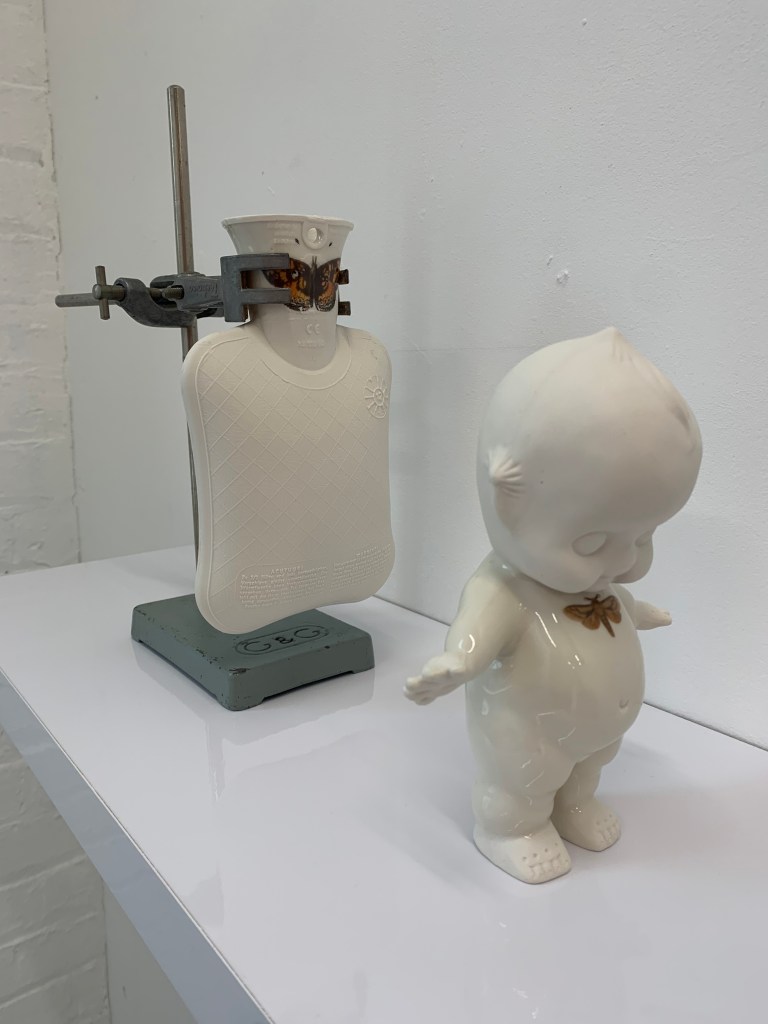
Nairn-based sculptor artist Emily Coulson teamed with curator, and daughter, Eliza Coulson and writer and poet Eliza O’Toole, established an exhibition within the Salt Space Cooperative Gallery from May 23rd to the 27th depicting the medicinal and ailment enforced processes displayed through visual and verbal prose. The hot water bottles – a dialogue-loaded object in artist’s Coulson’s visual language as a means to represent people – were held upright in scientific clamp stands by their “neck”. The teabag: an object fused with history and culture but within this space a source of palatable pleasure that has its own negative effects.
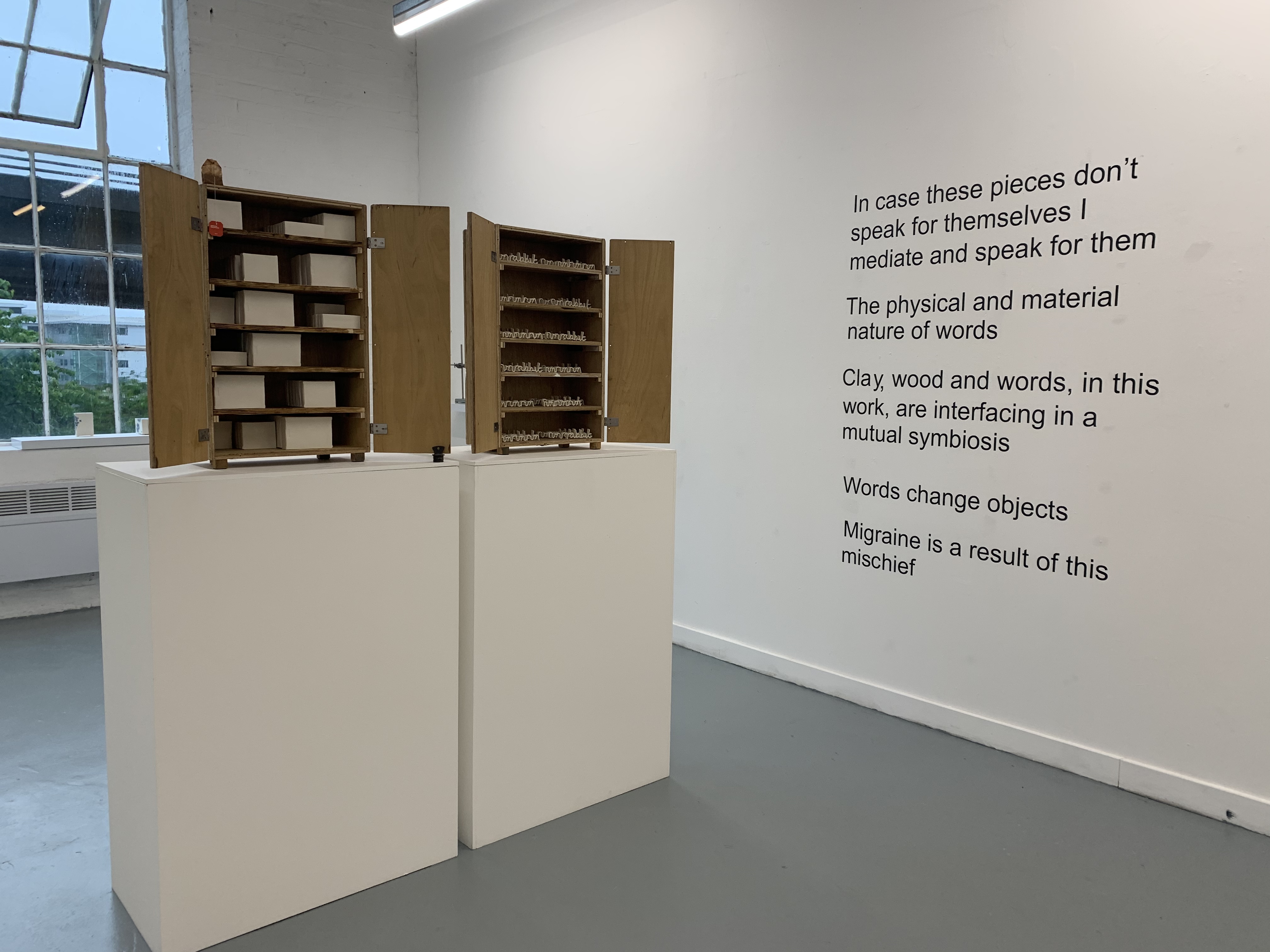
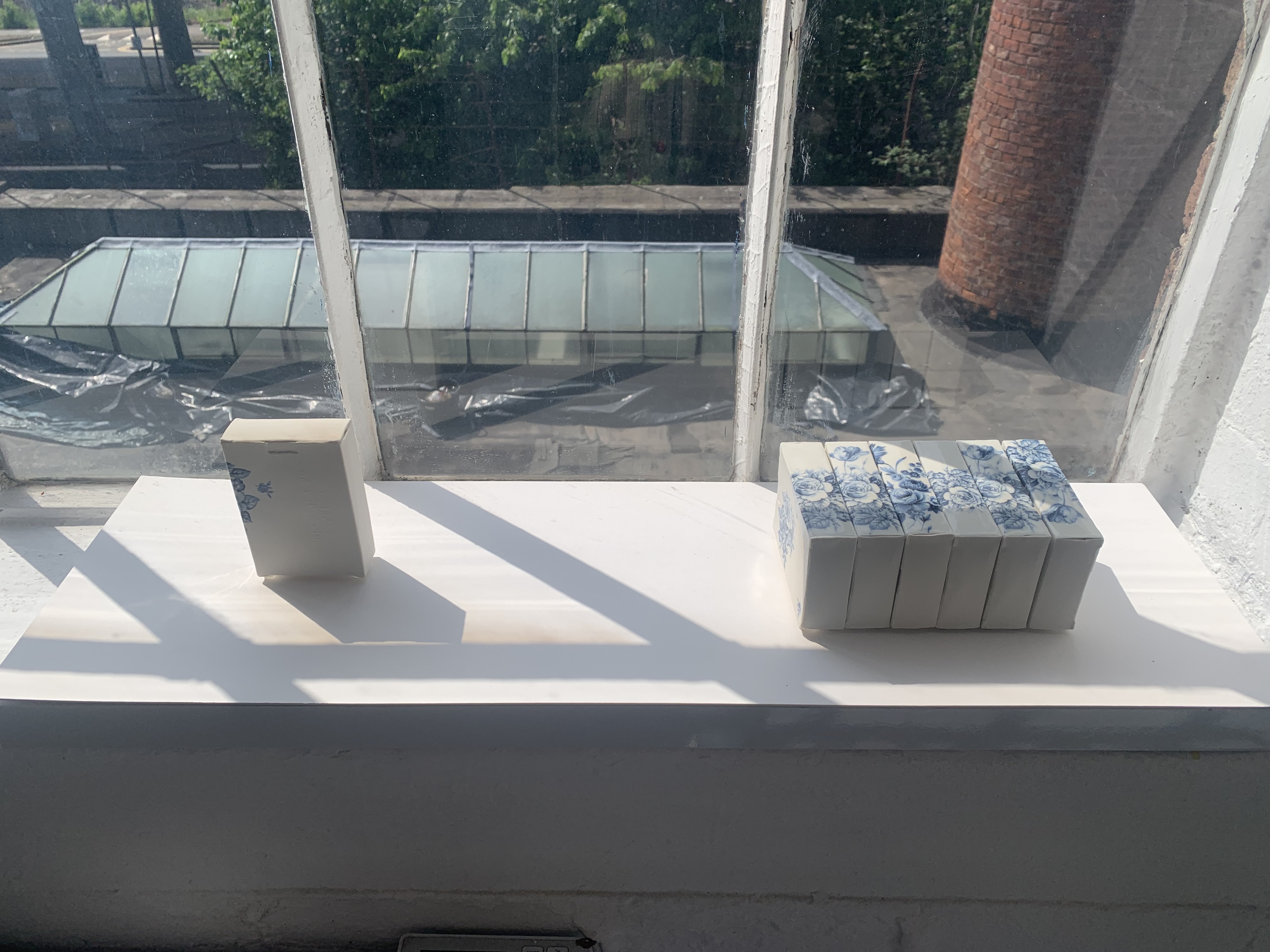
The hot water bottle and a cup of tea aren’t the only sources of distraction, in the right cabinet of ‘A Porcelain Poem’ (2019) there are rows of 2 porcelain-cut verses “run rabbit, run rabbit, run-run-run” over the 6 shelves. This repetitive use of the three notable lines a-liken to the 1939 World War II song Run Rabbit, Run becomes an idiom being that of a message to run from danger, such as the enemy and their arms of destruction, but in this case, it can be interpreted as the running or, rather, an attempt to divert concentration from the migraines. The stemming of the mantra is not an uncovered one as the artist was unsure when and why she began using it – perhaps an effect from the migraines and the medicines further demonstrating the effects of living with chronic illness. In the other cabinet with symmetrical shelves to its counterpart consists of rows of porcelain slip cast moulds of the artists prescribed medicine boxes; indications of pharmacy stickers and braille delineated as white shadows, capturing this lived experience.

Curator, and Gallery Bagging Co-Editor, Eliza Coulson shared her thoughts and hopes for this exhibition:
AJR: Congratulations to you and Emily for a successful exhibition at the Salt Space. Could you tell us more about the themes woven into Emily’s work?
EC: The work draws on parallels between different addictive substances… caffeine in tea and the various medications used to survive the day – the realisation of chronic illness living becomes less about the addiction to substances but rather the addiction of not wanting to suffer. In the work ‘A Porcelain Poem’ a used tea bag sits on top of the cabinet, a nod to its role in both enabling headaches as a withdrawal symptom and a reminder of the pleasure that a cup of tea can bring.
A visual language is created by the artist, through migraine and the effects of this illness on the brain, as well as the medications interaction with both the illness and self. Often alluding to the damage created, the loss of brain cells and the loss of the ability to verbalise thoughts and feelings are remnants of migraine damage and constant medication use. The work explores the strained but functioning state between this medication and aphasia* – as represented by the mantra ‘Run-Rabbit-Run, Run-Run-Run’, the repartition that plays through her mind during peaks of pain, the invisibility of the words in braille on the boxes and the unintelligible text covering the surfaces of the cabinets. These as well as the assemblage of objects are all depicting communication. The written response by poet Eliza O’Toole, addresses just this – the symbiosis of clay, wood and words.
AJR: You were both present throughout the exhibition, what interesting speculations or interpretations were shared with you?
EC: It was interesting to hear how people saw themselves in the work from both people with chronic illness and those without but having an appreciation of this struggle of health and living in this capitalist, productivity equating successful society. I noticed as the exhibition has a subtlety in terms of its ‘message’ but once people took the time to delve into the different symbols of the work they were surprised and engrossed in the technique and materiality, learning of the processing and the cast medicine boxes. There was a joy as well to learn and create a space of sharing a hidden existence.
AJR: What were your hopes for the exhibition?
EC: My hope was to create a space in which to highlight this liminal space of which people living with chronic illness find themselves, whilst also creating a space that is regenerative in talking about women’s health and hopefully others can see a reflection of perhaps their own illness, not just Migraine.
A newly added piece of work ‘Evocation of Death’ standing alongside ‘Moth’ created a subtle but powerful representation of this vice in life, the dark and the light, the life and the death, that all can relate to. With the signifiers of the butterfly, transformation and rebirth, and the moth, the night-flyers that are attracted to the light in the darkness, imprinted onto the porcelain Cupie Doll standing in front of the hot water bottle with the beetle burrowing inside, we begin to see a picture, a person being shelled from the inside out; a death. These fine lines we tread with our illnesses.
To put the objects together and build a dialogue between them creates an expression of a place many of us find ourselves in but we would much rather be somewhere else. These assemblages delve into memorised snapshots of events during a migraine attack – often resulting in an injection of morphine, ‘In the Ending of Nerves’.
Emily Coulson – artist
Having achieved a BA honours in glass and ceramics from Sunderland University Emily Coulson has gone onto work in a bronze casting foundry learning and understanding metal casting techniques. Taking the mould making and lost wax knowledge back into Sunderland University, she explored glass casting and slip casting processes during her MA studies. Emily Coulson has been featured in the Art North Project Room and has exhibited in Gallery Pop with ‘Cabinets, Houses and I’ as well as having exhibited on several occasions in the Royal Scottish Academy Annual Art Open Exhibition.
Eliza Coulson – curator
Eliza Coulson is a Glasgow-based multi-disciplinary curator, artist and researcher with a wide range of interests that are carefully interwoven under the themes of disability and inclusion, communication, ecology, and walking art practises as forms of creative research. Curatorially, she facilitates working with artists in workshop settings, furthering their projects centring on collective memory and experience through chronic illness. Eliza has a MLitt Curatorial Practise in Contemporary Art at the Glasgow School of Art. She has also contributed to the artwork in Eliza O’Toole’s art&poetry book Writelinge – I send you blue.
Eliza O’Toole – poet
Eliza O’Toole’s work has appeared in the Shearsman Magazine, Tears in the Fence, The Rialto, and Fenland Poetry Journal and also online at OSP. Muscaliet Press published her artwork and poetry book The Dropping of Petals, in 2021. Forthcoming in 2024 also from Muscaliet Press are a diptych of art&poetry books Writelinge – I send you blue and The Formation of Abscission Layers. Her first full poetry collection A Cranic of Ordinaries is to be published on 1 October 2024 by Shearsman Books. She was shortlisted for the Michael Marks Environmental Poet of the Year 2023/24 for her poetry pamphlet The Unpinning of Moths. She is a wildish gardener, moth recorder and companion of Labradors.
Written by A-J
 Gal bag.