“The ear is a faithful collector of all sounds that can be gathered within its limits of frequency and amplitude. Sounds beyond the limits of the ear may be gathered by other sensory systems of the body.”
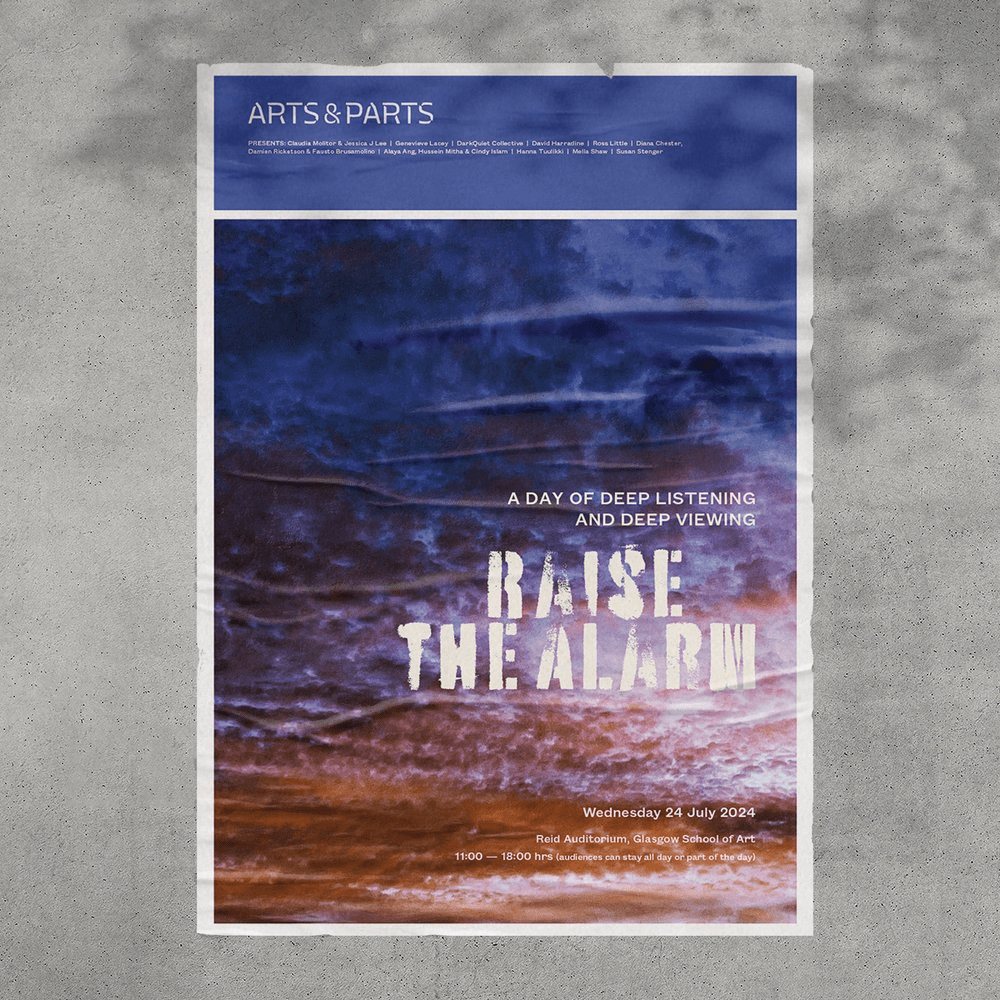
Raise the Alarm, a soniferous experience giving opportunity to the viewer to peer beyond the human perspective and into the acoustic ecology conductor that is our planet. Martel Ollerenshaw, curator of this deep-listening event-intersected-with-exhibition, took over the Reid Auditorium in the Glasgow School of Art’s Reid Building on Wednesday 24th of July 2024 for this long-form one-day only showing. Through the audio works, Ollerenshaw was able to give voice to the artists who give voice to the natural world around us, taking humans off the pedestal and instead highlighting life through captured raw sound as well as collaborated songs between the human and non-human with the occasional inclusion of poetic visuals. The immersion of sound truly indulges the senses, familiar rhythms enabling deep-imaginings of things such as the weather, of the land, of the sea, of the micro, of everything tellurian. Raise the Alarm frames the intentions of the project in a way that opens internal conversations, it isn’t a carnivorous plant luring the viewers into a fear trap but to a soft invitation offering a momentary soundscape to listen with the world and environment around us.
Numerous artworks ranged between locations like London, Edinburgh and the Hebridean Islands as well as Australia and even up in the High Arctic. David Harradine, the artist behind It’s the Skin You’re Living In (2012; 8’30”), who filmed in the High Arctic on one of the Svalbard islands took off southward through the UK continuing his journey as the central character shed out of the polar bear suit reminding the viewer that yes, this is a global crisis which includes your front doorstep. It is a present concern in our day-to-day lives breaking down the ‘ignorance is bliss’ delusion. Him standing by the motorway, decanting himself from the pelt and pads, the emissions melting him away, the metal bodies shredding him to pieces as they bulldoze past fills my mental-imagery. Images of the Svalbard Island where he stripped out of his insulation into his bare skin, the cold not biting as it once did, and the yellow of the coat no longer reflecting the white snow as it once had.

Thinking of the motorway, thinking of the wheels on the road blurred by the motion accompanied by the crackling sound of the ground beneath the rubber. It places me in the seat, I don’t have music on as I enjoy the sounds around me, listening to the crunches, the whirs, the breaths that cars take as they stop, start, break, turn, skid. It’s not only inside of the car I welcome non-human sounds, but I also carry on outside with no headphones constricting my skull, no ear pods to ache the cartilage. I let my ears breathe, inhale the sounds and exhale the pressure. I can hear internally the sounds of stones clanking off one another as they skirt down a hill’s chute; waves pushing and pulling; trains crossing bridges; rain hammering off cars; post-rain dripping from my plant pot gutters. In Mìle Dorcha (The Dark Mile) (2023; 15’53”), Ross Little captures these moments between the non-human and human-made, to which I tried to capture those motion images in brief words.
lights
trees, flickering
Night vision badger.
Crisp leaves.
Machines humming
whirring in
the pinewoods.
In Little’s 16-minute film, we get a sonic glimpse at the human activity encased within metal bodies born solely to deconstruct the trees nestled within the ancient Caledonian pinewood now known as the Arkaig Community Forest, West Highlands, Scotland. The film’s intentions were to break past the “human perspective” and to reflect on our relationship with the natural world, bringing a visual of wildlife building a relatability between them and the viewers. Soft clangs and hums of the efficient wood chopping mechanisms can be heard alongside the gentle flow of water and cawing of mischievous crows. A scene that has embedded itself in my mind is the field with tree stumps hidden behind long grass and wild foxgloves, a flurry of green-yellows and pink-purples enlivening the space where trees no longer stood. The foxglove itself is an interesting specimen, theories around the name point to the visual shape of the flower but also the tale of foxes using the cup-leaves as gloves to silence their steps aiding them to gently manoeuver away from hunters. They couldn’t help the trees but can help the foxes, and if not that, their nectar can feed the bees as a reward for their pollinating efforts. Although the machines made and powered by humans strip the trees with a concerning hunger, the animals continue living and nature continues growing.
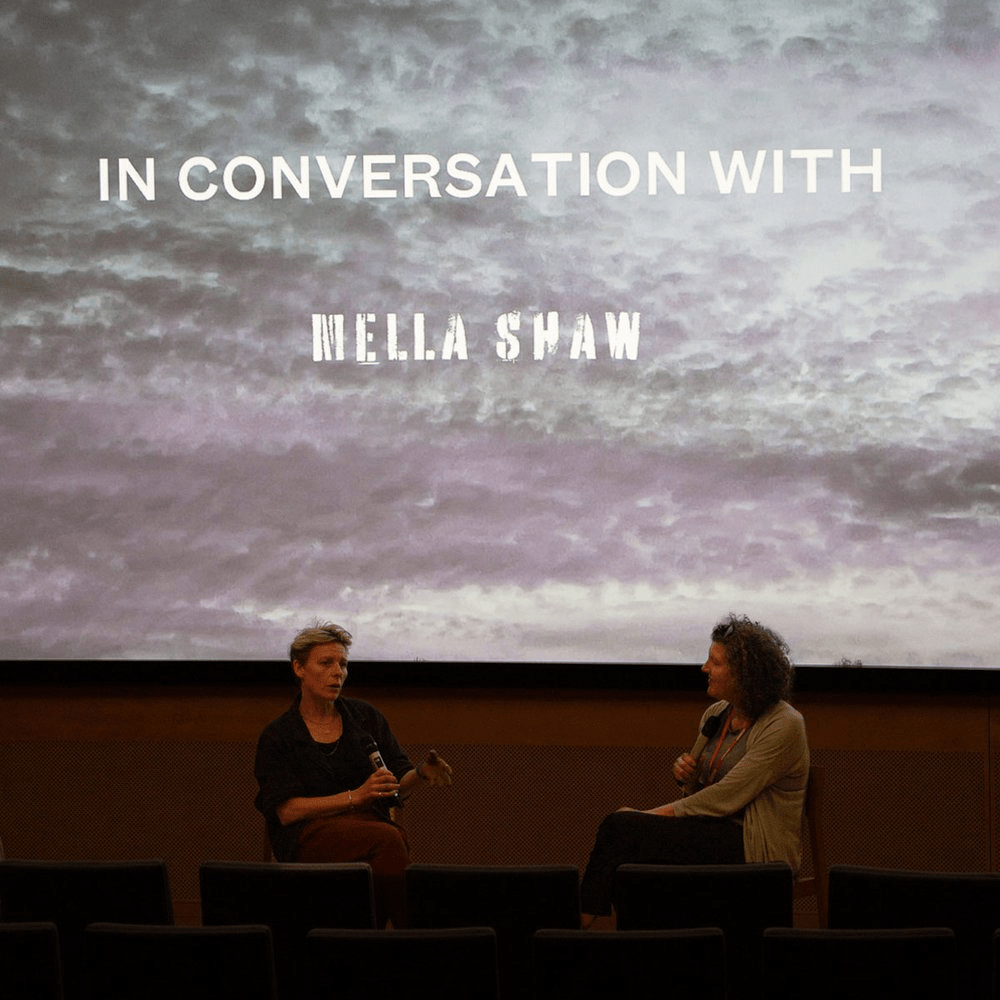
Little’s film is hopeful with signs of life prospering whilst living within their woodland home, sadly, not all creatures have lucked out on the lottery of collaborative living situations. Whales have become victims of invisible side-effects from armatures we thought ground-breaking on the eco-friendly scale. Wind farms near the Coast teamed with naval submarines and other sonar-wave producing human-made contraptions are causing upsetting and fatal effects to our cetacean friends. British Ceramics Biennial 2023 winner Mella Shaw and her award receiving project Sounding Line (2022; 6’) highlights this repeating issue of these sea dwelling creatures, ranging across several species, ending up beached in masses across the UK’s West coasts, one as recent as the 11th of July 2024 where around 100 long-finned pilot whales were found on the isle of Sanday, Orkney. Shaw spoke at the showing after her short silent film, describing the origins of this project and how she tackled the legality of obtaining whale bone as a means to combine it with clay to mimic inner ear bones from a whale. From seeing the exhibition and film at the Summerhall Gallery, Edinburgh, to then seeing it on the cinematic-auditorium screen revealed the visually spectacular gradients of black and white sand as she dragged the unfired whale bone-clay ceramic back to sea, where it gently dispersed into the waters. Truly nothing short of exceptional in its delivery.
This deep-listening and deep-viewing experience was eye-opening, heart-wrenching, soft in its telling, and sensorially tangible. There were so many other incredible audio- and audio-visual works by artists, composers and filmmakers: Hanna Tuulikki, Susan Stenger, Alya Ang, Hussein Mitha, Cindy Islam, Diana Chester, Damien Ricketson, Fausto Brusamolino, DarkQuiet Collective, Genevieve Lacey, Claudia Molitor and Jessica J Lee.
I look forward to engaging with environmentally charged visuals and/or phonics under the curatorial care of Martel Ollerenshaw.
“She calls the voice, in which she learns the world again…”

The quotes come from books that were available at the exhibition’s reading corner.
Quote 1: Deep-Listening: A composer’s Sound Practice (2005),Pauline Oliveros, page 19.
Quote 2: Silent Whale Letters (2020), Ella Finer & Vibeke Mascini, page 39.
Read the piece on the Arts & Parts website with a comment from the curator herself!
https://www.artsandparts.co.uk/blog/seven-soniferous-hours
And please sign up to The Particle newsletter whilst you’re there!
 Gal bag.