As always, we invited peers who were intrigued by art and the context that it can pose. In this session, we focused on the aspect of sound and its place in geography, war, and art. Engaging with our memory of space and our connection with sound physiologically.
In this session, we set off to the David Dale Gallery to respond to Closed Caption Silences by artists Zoë Irvine (UK) and Photinus Studio (UA). The collaborative artwork consisted of three tv screens and three shoulder-height speakers (screens parallel to their respective speaker). Each screen presented English and Ukrainian captions demonstrating a translation of recorded audio into verbal descriptors accompanied by visuals of their respective sound waves.
The installation sought to capture the sonic landscapes of Ukraine in contract to multiple places providing sounds from various geographic locations such as Hamburg, Amsterdam, Venice, and Edinburgh. Dedicated to the sounds of non-human life, the installation explores the contrasts and connections between the two environments (UA and UK) – referring to the ‘accidental’ nature of everyday life. The sounds played and described led to the [synonym] group discussing a lack of noticing our own soniferous surroundings, subconsciously categorising them as insignificant. Realising our ignorance to our ecosystem’s polyphonics, to us, indicated a privileged sense of safety. Separating us from the countries subjected to war, entailing sirens, raids, bombings, and a whole militia of destruction.
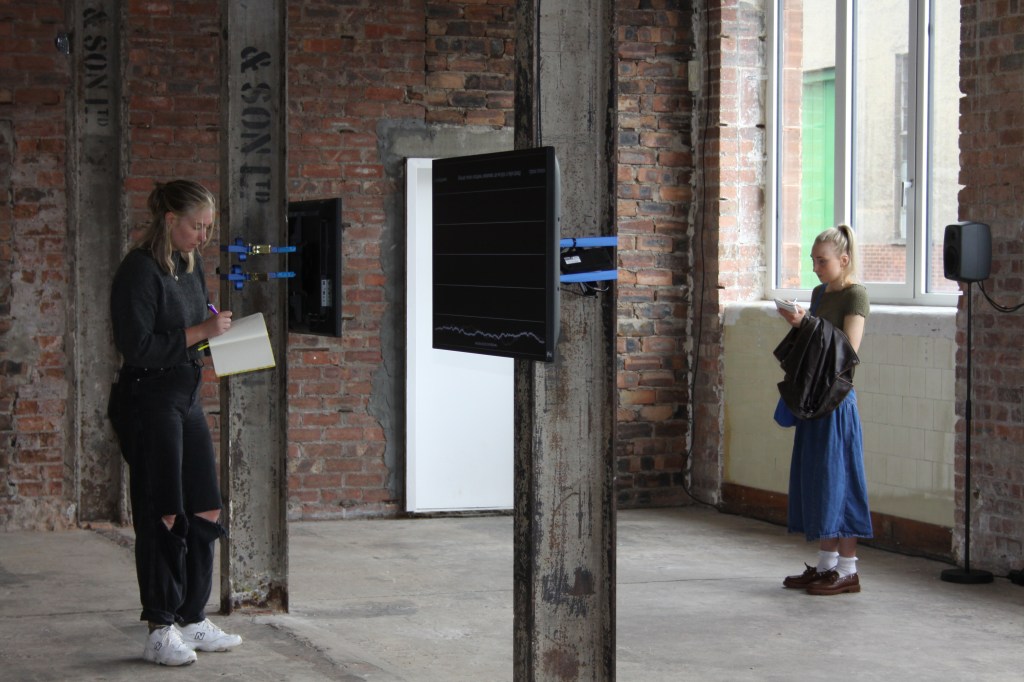
We think of the festival, and we think of the title of this installation. They think of silence, which makes us think of silence. We deliberate on the meaning of silence and what true silence would suggest. Closed Caption Silences was initiated in the earnest effort of finding silence, but instead emerged barking dogs, singing birds, leaves rustling in the wind, all matters of sounds produced by life. The result of active listening led the artists to hear and understand the more-than-human world we live in.
It brings us back to the meditation of silence. We know silence represents an end, true silence is a loss of nature, of the wind, of chatter. It is a result of devastation. Silent Spring (1962) by Rachel Carson comes to mind. Her observation over the indiscriminate application of agricultural chemicals, pesticides, and other harmful chemicals that pollute our streams, harm birds, and affect both animal and invertebrate populations, inadvertently silencing Earth. Carson focuses on chemical destruction and the potent impact it has on the environment and its ecosystems, our very own neighbours. Akin to this human-made chemical warfare, war is one of the biggest ecological enemies, especially as modern weapons become more chemically sophisticated.
But please, take refuge in the active sounds of birds and their lively chirps, the ambient buzz of insects, and the vivacious yapper of dogs. They indicate that all is not lost and still thrive alongside us.
We appreciate that ourselves and our writing cohort haven’t experienced sounds of war, instead we honed into what we have lived and heard as well as actively listen to the present. Prompting the writers to access their own audio-memories to disperse them through visual constructs. Words, shapes, squiggles, colourful lines, allowing a moment to shed ourselves of mature etiquettes and allow ourselves to enact child-like serendipity across paper.
Representing memory as scores presented a different mode of experiencing and enacting ‘art writing’. Channelling this method of response, we explored writing as a visual tool enabling a pathway to connect with the audio within the installation. We can’t always interpret sound through words, so we choose to shift our lens (ear) and use the avenue of mark making to capture it. Building a relationship with how we interact and perceive sound, strengthening our understanding and connection with it.
Before you get to reading the fun part with the creative writing produced, we’d like to leave you with the questions posed by the festival, perhaps produce your own response to it:
“In a world where focused listening is the biggest luxury, how do we attune to the sounds that escape human control – what does it mean to listen to today? What does it mean to trust what we’ve heard?”
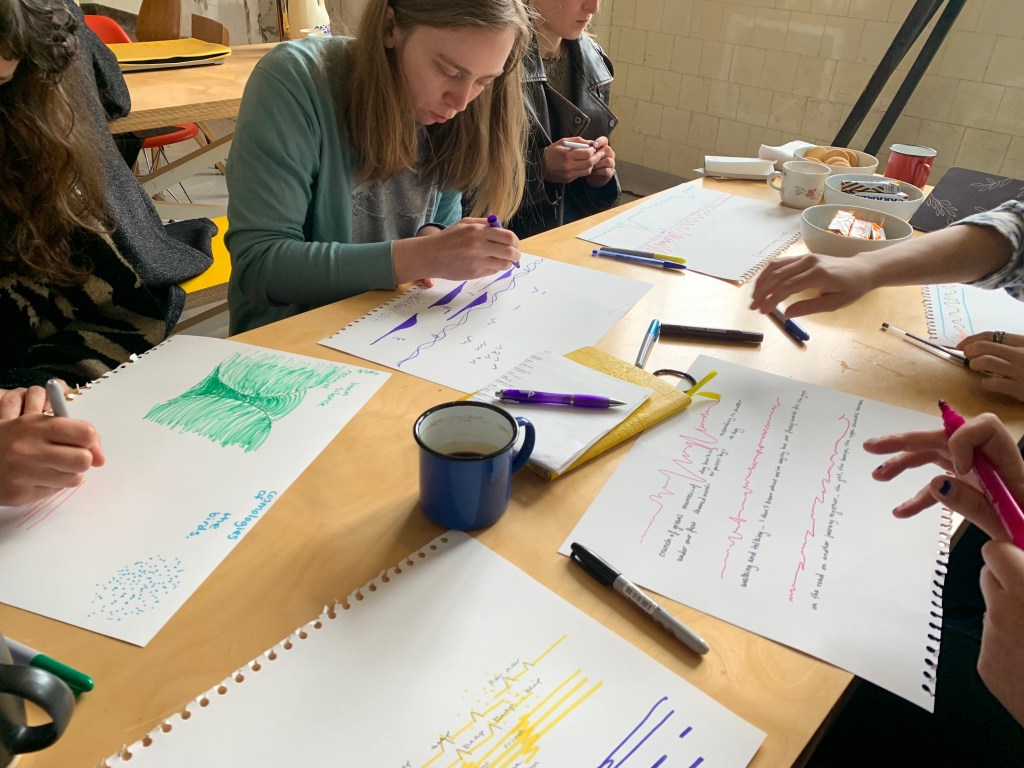
Alba
Producing a sonic architecture sourced from memory
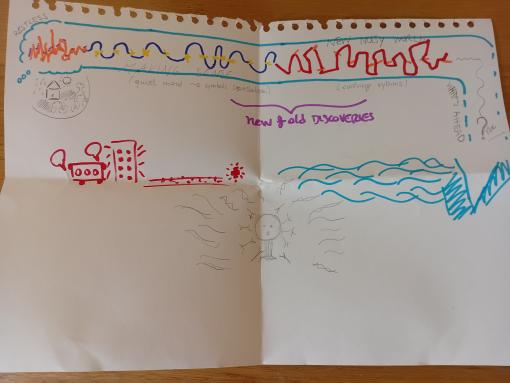
Izzy
Producing a sonic architecture sourced from memory
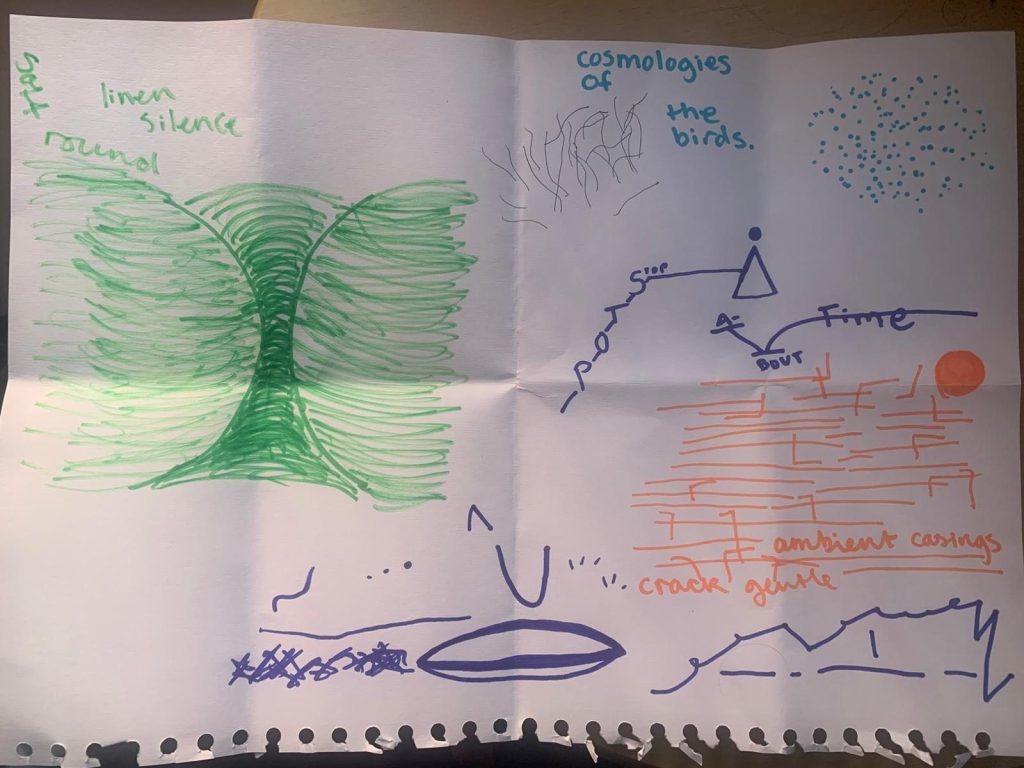
A-J
Producing a sonic architecture sourced from memory
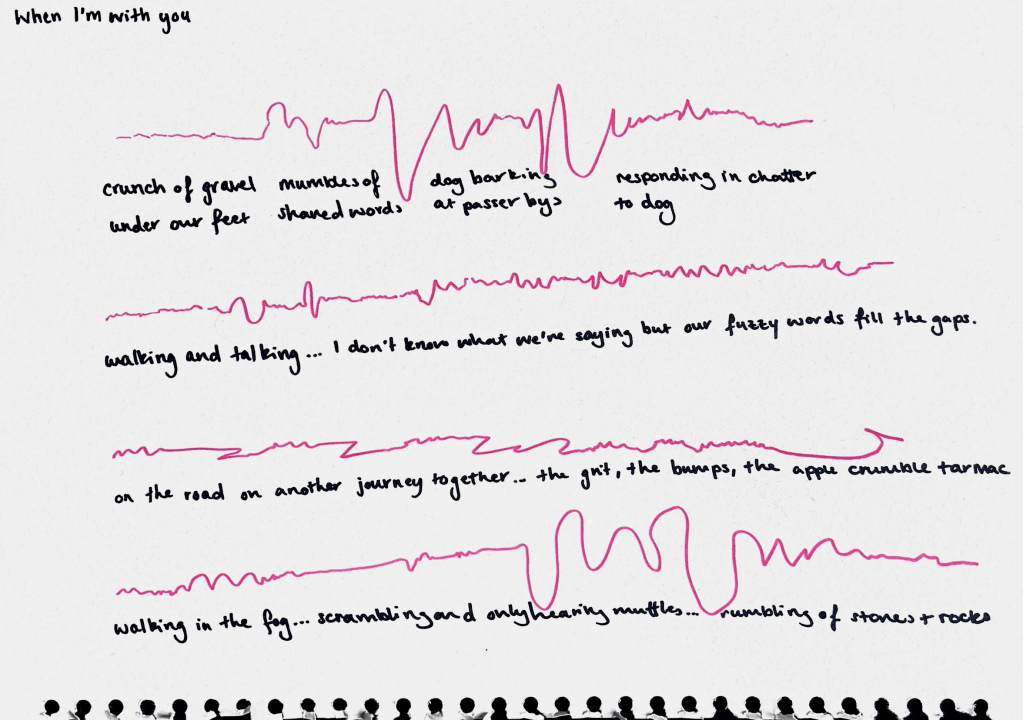
Izzy + Sarah
Producing sonic memories
Thank you to Time-Based and Arts & Parts for inviting us to join along using our creative lenses to observe, absorb and respond to SONIC INTERVENTIONS.
Thank you to the writers who joined us, your support and magical words always make the session such an inspirational experience.
Thank you to Photinus Studio and Zoë Irvine for presenting such powerful works of art for use to delve into with our writing group.
And thank you to Aliya Prichard-Casey for taking these stunning shots! Credit to Aliya for the poster image as well.
Our next [synonym] write up will focus on Ciara Phillips’s Undoing It, exhibited at Glasgow’s Gallery of Modern Art. Guest host artist Maria Soroniati held the reigns on this one, encouraging a collaborative approach using image and text as the main prompts.
Sign-up to our newsletter if you’d like to see what we’re up to, been up to, and what other exhibitions and artists we’ve highlighted are up to, linked here.
 Gal bag.