
Inside the Modern Temple investigated the vast language of humans concerning ideologies and fairytales told and retold throughout time. The works range from different styles and mediums: digital print to installation to oil painting to photographs (one of the two works was photographic documentation of a performance).
As Edinburgh-based artist Zefeng Li spoke about each piece from door to window of the 38 Albert Road Saltspace gallery, Glasgow, he identified the stories that informed the various artworks presented. For a few of the pieces, these concepts were not only informing the foundations of the artwork but a lot of the body leaving a notable gap.
He describes the exhibition as a reflection on human history and individual existence. Li looked to analyse how the human condition is influenced by the different cultures and stories learned through language. He went on to explain his aim “to find answers to difficult questions” by analysing patterns occurring throughout history evidencing the repetitive human nature of conflict, oppression and suppression. Setting his sights on cultural bubbles and the different behaviours exhibited within them, his hopes for this modern temple was to be a place where people could connect and understand.
Taking on such huge themes all at once resulted in the narrative feeling quite disparate. It would be great to see the artist focus on one research area allowing him to delve deeper into the crevasses of this topic; allowing him to assemble a more cohesive output. Art can indeed be used for a language, however, for this language to be understood there needs to be a narrative made accessible for its translation. Although, this is an impossible task as not everything can be read and understood by everyone.
As the artist is attempting to explore human behaviour through culture, this would suggest an undertaking to observe how each of us are influenced by our own individual upbringing / environments and the influence it has on semiotics; meaning not all can be interpreted as intended. The concept of ‘humans’ is too vast to compress. If we explore places around the world (ie, China, India, Africa) we realise that not one ‘human culture’ can be described. What makes us human, other than the physiological? To undertake this question is a big one.
We encourage this keen interest in researching big subjects but to start small. In that net there is space to navigate not only the external resources but also the internal resources—the artist themself. Where is the connection with the subjects, how do you connect yourself to these subjects, what is the interconnective tissue between artist and artwork?
With that in mind, Neolithic Revolution is a great example of this artist being present in the artwork. As Li explained his enthusiasm in discovering new information, he subconsciously became the green orb with its blue reaching tendrils/tacles.
It’s quite easy to be impressed by the explorative nature of Li’s creative work, it shows a clear sense of wanting to tackle “the bigger picture”. With this being said, we want to emphasise that the themes explored in this exhibition are a multiplicity of vast subject matter conveyed through one individual’s lens. Hone in to what is uniquely yours and make that space explode with your magic.
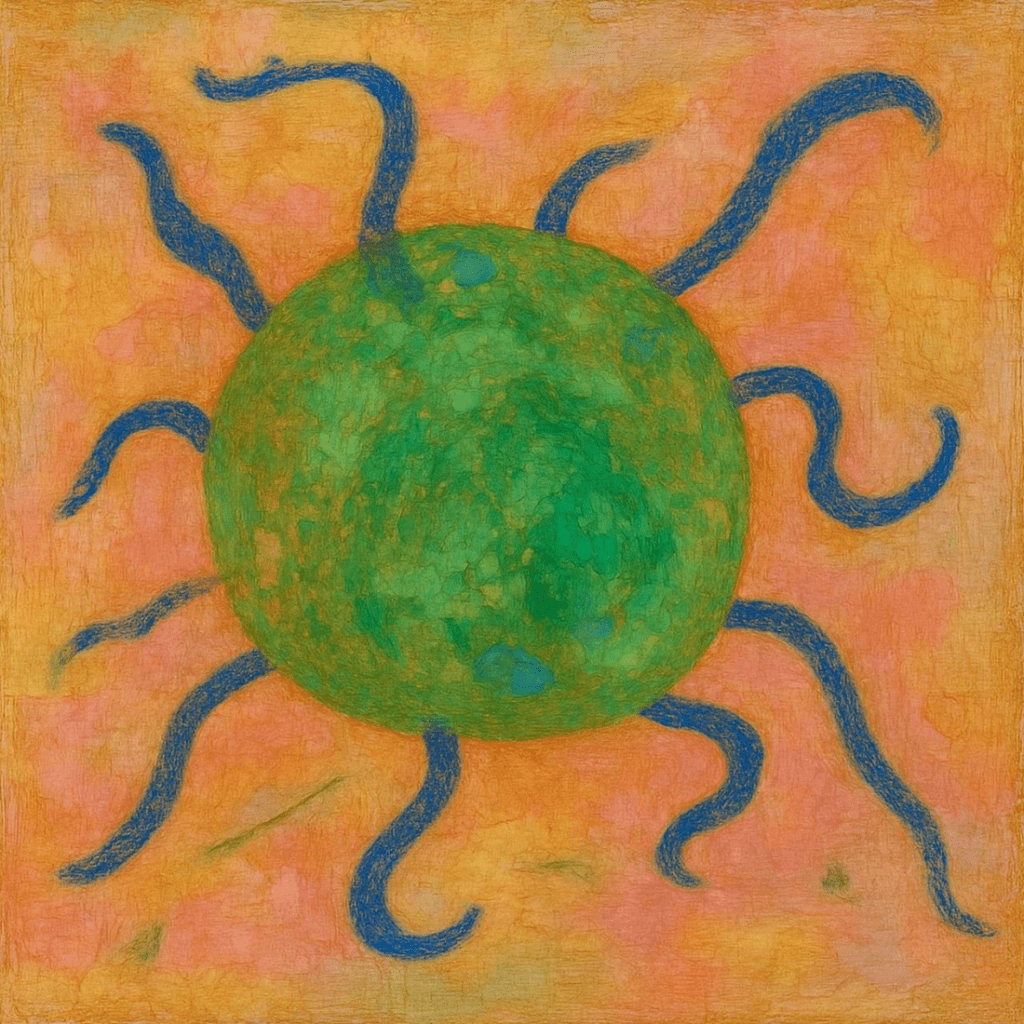
Neolithic Revolution by Zefeng Li
Critical review by A-J Reynolds and Eliza Coulson
We’d like to thank Zefeng for reaching out to us with the opportunity to view and review his fantastic work ❤
 Gal bag.