
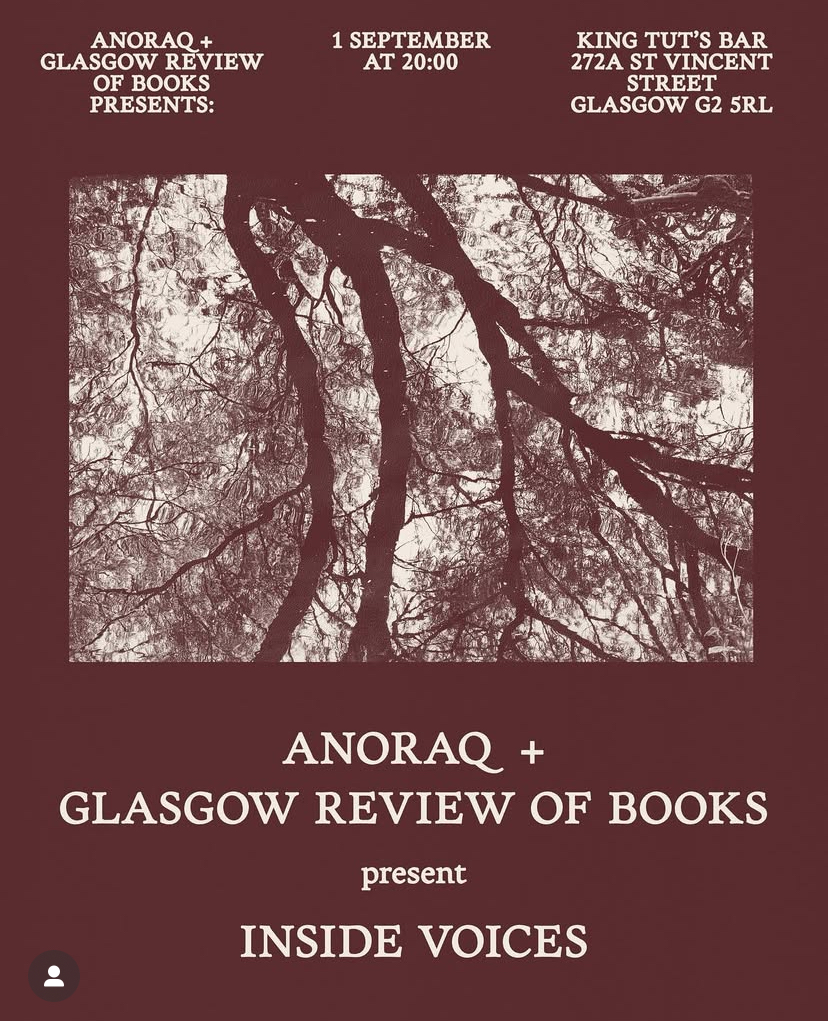
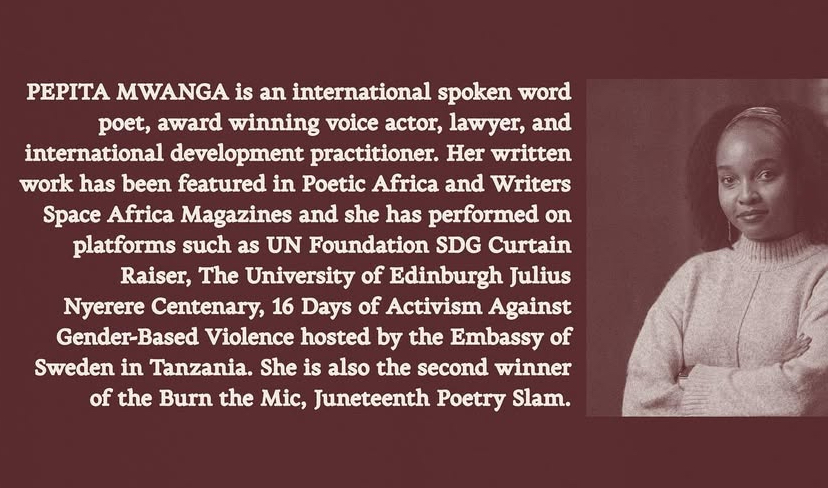
We find ourselves visiting Inside Voices, a collaborative poetry night with Anoraq and Glasgow Review of Books, housed in King Tuts. On this night we hone in on poet and writer Pepita Mwanga who shared her words alongside other performers; all accompanied by live impromptu music.
The music from Anoraq was improvised based on the poetry creating a space in which trust and symbiotic confluence was pinnacle. The back and forth correspondence between music and poetry created a reverberative ambience—music and words blending. However, at times, the base and scale of the music drowned out the poet’s words, unfortunately, overpowering their lyrical craft.
Naturally, this was cause for concern for Mwanga’s segment. Sitting intently at the back there was instant relief as Mwanga’s words carried across the space with great diction and good base. Not only did Mwanga clear across the music she also found a good harmony with the strums and chimes as she read her poems ‘Monday’, ‘In Love’, ‘Bad Hair Day’, and ‘Dancing Hormones’.
Our poet’s theme focuses on domesticity, the everyday, and the bliss of nothingness but paradoxically highlighting the everything-ness that comes with the ebb and flow of life. These little insights are revealed in ‘Monday’ and ‘Bad Hair Day’. Both highlight fragments of her life; from redefining relationships, “taming” 4c hair, to the vacancy of quitting one’s job.
‘Dancing Hormones’ presented a chaotic rhapsody delineating the hormonal changes within the body. Introduced with an apt “be kind” to the poem about her own experience with menstruation. Mwanga charges in with the same vigour as our hormones as they wreak havoc both internally and externally. Chanting a bodily dialogue, telling and retelling inner battles that seep through the surface. Navigating us through care, love, and tears. The music continued in the background alongside Mwanga with a more ambient and melodic rhythm which balanced the fast paced rhythmic words while also defusing the charged verses. A true symbiotic dance.
In conversation with the artist post-event, she told us about one of her poems titled ‘Don’t Touch My Hair’. This is a poem whose reception is affected by cultural and social contexts based on the location it is told in. ‘Don’t Touch My Hair’ sought to spotlight cultural behaviours and expectations by softly challenging societal norms in her home country of Tanzania, however, it becomes a different narrative when told in other countries, particularly, Western. From this experience, Mwanga has noted a change in her approach from how she read and wrote in Tanzania to how she writes presently in the UK.
We also spoke about her practice and the changes that it has seen, she expressed her wishes to continue developing her work in the direction of visual language. Her method is to use sound as her base for generating her work; finding space within the rhythm and working into its melody, It was interesting speaking with Mwanga as we delved deeper into her practice as she continues to develop into the visual language. Her method is to use sound as her base for generating her work; finding space within the rhythm and working into its melody, a flow submerges from its phonic counterpart to create these lived experiences told through her poetry.
Written by Eliza Coulson + A-J Reynolds (GalleryBagging)
 Gal bag.