I am delighted to write a review revolving around my creative colleague and co-GalBagger, Eliza Coulson, and her most recent launch of Walk Write Blether (also known as Write Walk Blether) on Saturday 15th of November. It was great seeing new and familiar faces at this crisp outdoor event and, were pleasantly surprised by blue skies and cotton candy clouds with minimal winds.
The thing about WWB is that it stems from Eliza’s research and practice, it is something she has deeply rooted herself in through filaments such as disability and inclusion, communication, and, of course, walking. Using her body to explore internal and external factors, through this she experiences herself, focusing on the ending of nerves, honing in on her limitations and her abilities. Folding these elements into a language that delineates the culture of chronic illness through her own practice.
I’m sure you are eager to hear a bit more from the Gal herself, so we’re treating you to some quips from Eliza surfaced by a couple of questions I’ve sent her way. So, without further ado, let’s get into it.
A Walk in the Park
In the event description, Eliza had highlighted a book that would act as inspiration for this event titled Path, A short story about reciprocity by Louisa Thomson Brits. With her book, Eliza sets the woodland stage as she recites the opening quote:
“For as long as I can remember, I have walked to experience harmony with the earth and, in the words of Nan Shepard, to ‘know being’.
“Path is an invitation to wander and wonder, to experience radical openness and fidelity to the movement.”
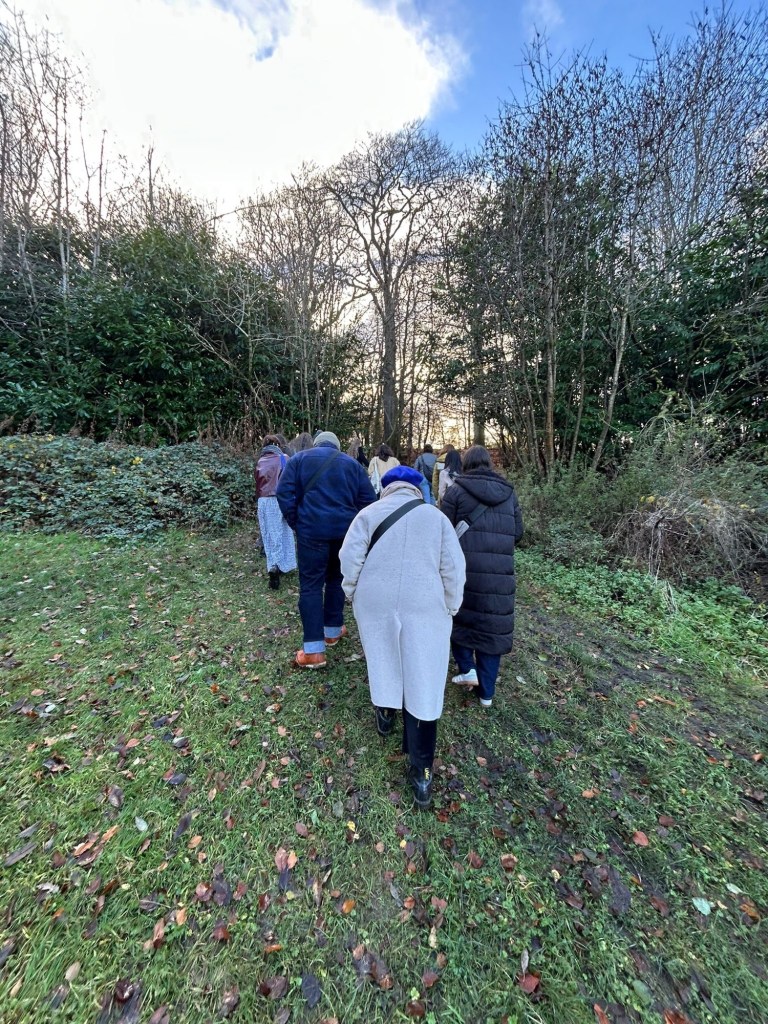
There was fidelity to their movement – alright! As I stayed behind to wait for remaining participants the group moved at a fair rate of knots through the park, along the grey path and up the hill. I wonder what the walkers were thinking in that moment; the excitement they were feeling, their eagerness to traverse the grounds as they were filled with words teaming with fresh air and a desire to explore their body through the environment.
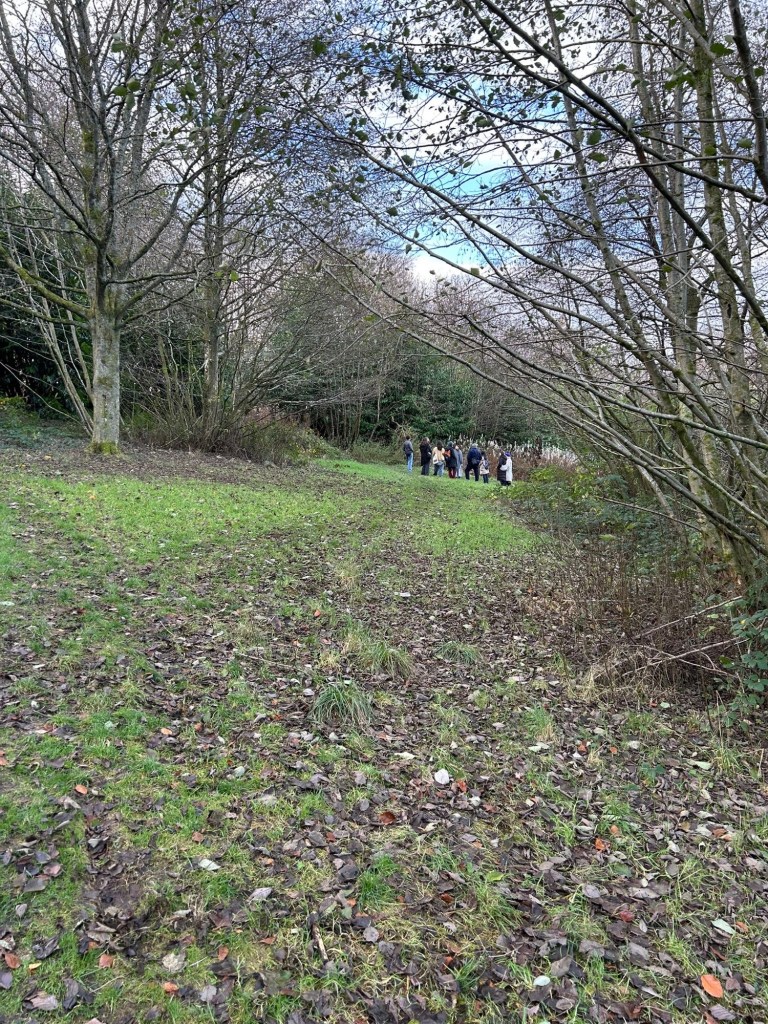
To know being, to feel the nerves, the burst of synapses, the beholding eye, the extension of the self gliding through the world. The body is magical and exciting, all those pieces that we deem as faults, flaws, failures, can be seen through a different lens and used as a source to discover our own radicals. I feel with WWB, this could be a space for travellers who wish to journey the internal in conjunction with the external; a sort of nomadic meditation.
Destination [site]/[sights]
Although not present, I knew Eliza would have begun the guided portion of the session where she would read:
“Walk,
only walk
kiss the ground with your feet,
always arriving
into the here and now
There is no destination, nothing to do, to change or mend but wander with me to remember the land…”
Touching on surroundings, tasking the senses to collect notes on nature (human and non-human) from the sites and sights around us. Abandoning direction and navigation as the path filled in that role for them, all they had to do was kiss the ground with their feet.
Gliding towards the second portion of the walk they reached a space off path, switching grey routes for green grass.
A-J: You’ve incorporated the holy trifecta of your practice – walking, writing, and blethering – and have enabled participants to take part. A lot of the walking enthusiasts commented on walking as a practice, remarking how interesting it is. Could you explain why walking?
EC: The idea of walking art practise as creative output, came from my love of walking, from daily comfort walks, to being in the mountains, to walking 96 miles in 7 days and to the joy of just walking around my parents garden. I became intrigued by my body’s connection to land. During my masters I focused on relationships between walking and living with chronic illness and how that can be a tool for communication. By creating ‘walking scores’ that focus on the landscape of the body when being traversed through the land – I noticed a dialogue being created between walking and body. This work is a continuous practise as chronic illness is not a static being.
My connection with walking, like everything, has been through many renditions, from before diagnosis, experiencing active illness and then into recovery, and balancing this fine line. A lot of my walking was solo, or accompanied by my dad but recently I have been enjoying walking with groups, with scattered long solo walks in-between to reconnect with my independence. This event was a space to demonstrate the importance of bringing people together, exploring slow time and generative company. Sometimes it is the small things that can have the biggest impact, gathering to walk, talk and read is a way to offer this.
The Queens Park Observatory
This enclosed slope was the perfect viewpoint, it was like looking from an observatory. Isolated and enclosed, yet the view opened up to a piece of the world. It had framed both natural and human spaces: hills, houses, trees, spires, leaves. All tangible collections that coincide and clash, retaliate and relate, be forged and be foraged. It was here Eliza let the participants slip into the canvas:
“Pursue a track in the land, a train of thought and I will draw you on and up, over a trail of white stones and bruised stalks, while the mist diffuses and resembles your purpose, rain-veiling and revealing our path.”
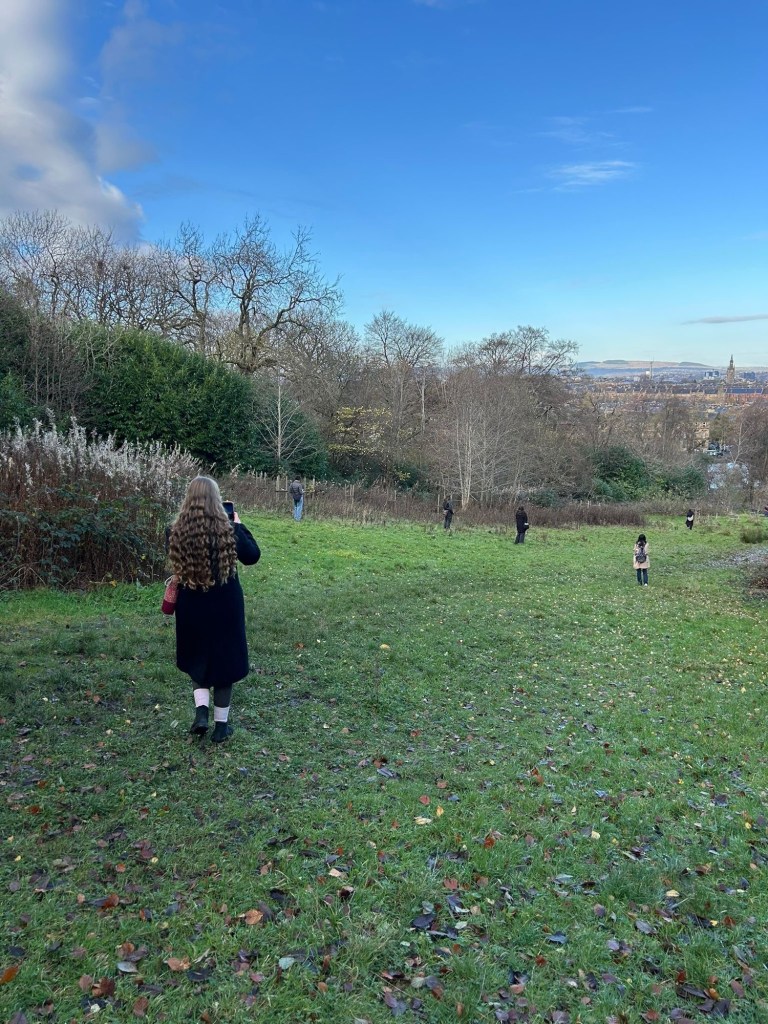
Unfortunately (but also thankfully), there was no rain, but the paths were revealed through multiple pressings from foot traffic leading up into the trees, over into the thickets, and down to the cup of this open grassy land.
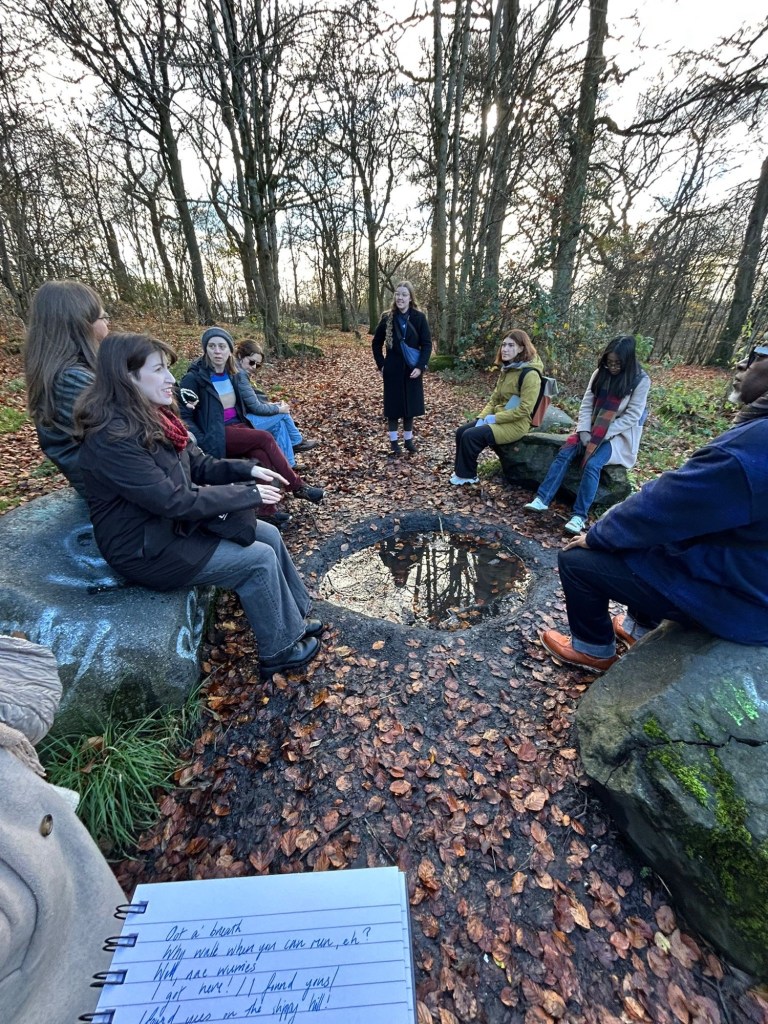
As I approached the group, I heard Eliza encourage the act of listening as she implored the walkers with a conversation on true silence (something we picked up from SONIC INTERVENTIONS). Previously, we wondered what true silence is: is it a good thing, is it an internal and/or external matter? Eliza spoke on the latter. Encouraging the participants to think of internal silence as well as external, with the bustling sound of the city, silence isn’t something that can be achieved but perhaps a thought, an internal space, a mindscape could be sought and there true silence may be found. Maybe.
What the walkers did find was details in the scape around them. One spoke of focusing on the textures of leaves, and referring to autumnal trees with their sparse leaves as having “bejewelled branches.”
Goodbye and thanks for all the step counts
As we walked down the hill towards our starting point, we wound up the session. Speaking about the value of listening and observing our bodies in response to the environment around us, and how this session has allowed a channeling of the act.
A-J: Where do you see WWB going?
EC: I would love to take this further in a sense of time and space – literally, more time and more space. The first event felt quite condensed because I wanted to see how the event would function and I now see that to invest in slow time, more time is needed so perhaps it would be a day excursion out of the city and into a more rural setting to allow people to feel as though they can disconnect and delve into the concepts and the scores. I would like to suggest areas such as Dumgoyne, Campsie Range, Kilpatrick for example – within the hour, accessible from public transport from Glasgow.
It would be great to devise a way in which this event can be archived / experienced by those who can’t attend, perhaps through a radio broadcast or live stream?
A-J: What was the highlight of this event for you?
EC: I would say the highlight was all the people who joined and the community that was fostered!
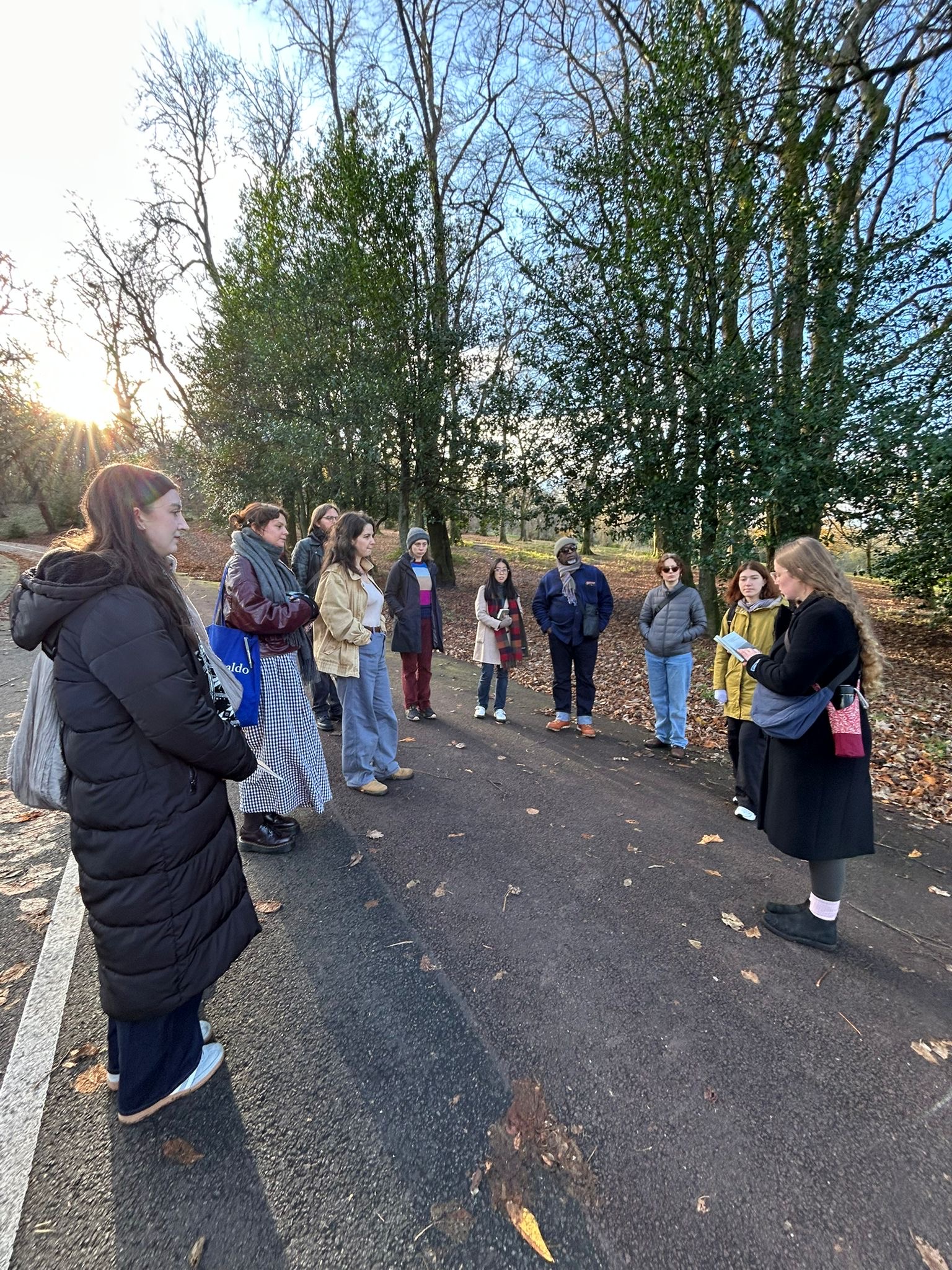
Thank you to everyone who joined the Pilot walk for Walk Write Blether!
We’re so excited to see where this kind of event takes us, perhaps not just Glasgow~
Stay tuned to see where WWB will take us next in the new year.
Cover Photo by Eliza Coulson.
Photo Credit A-J Reynolds.
 Gal bag.