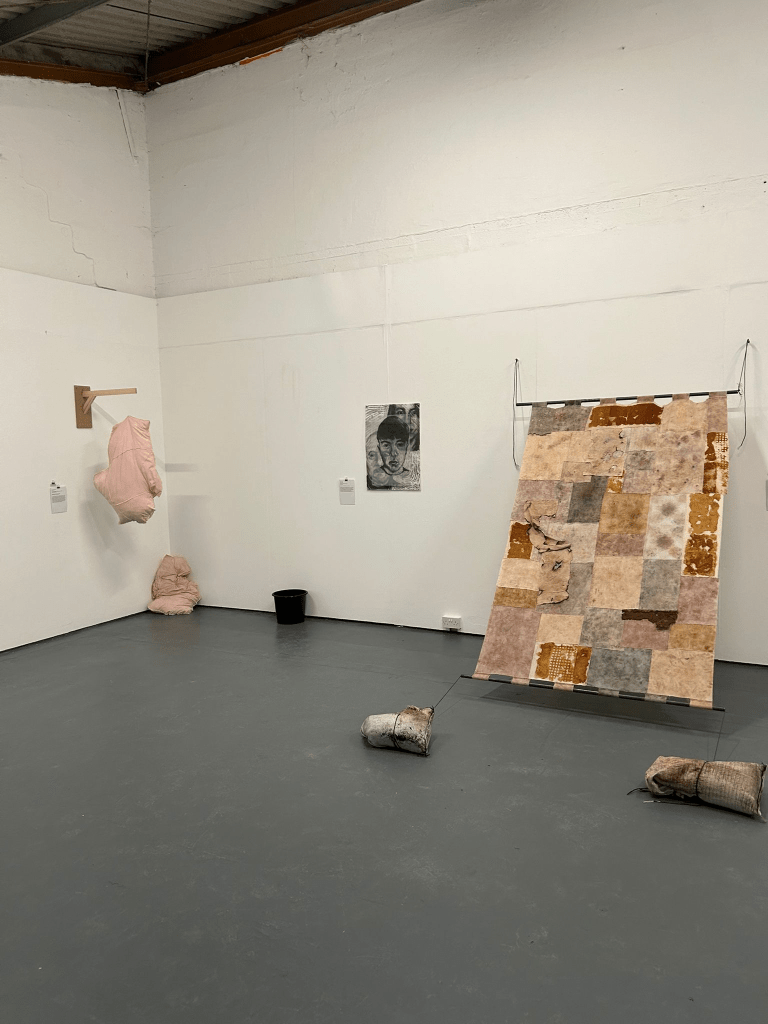
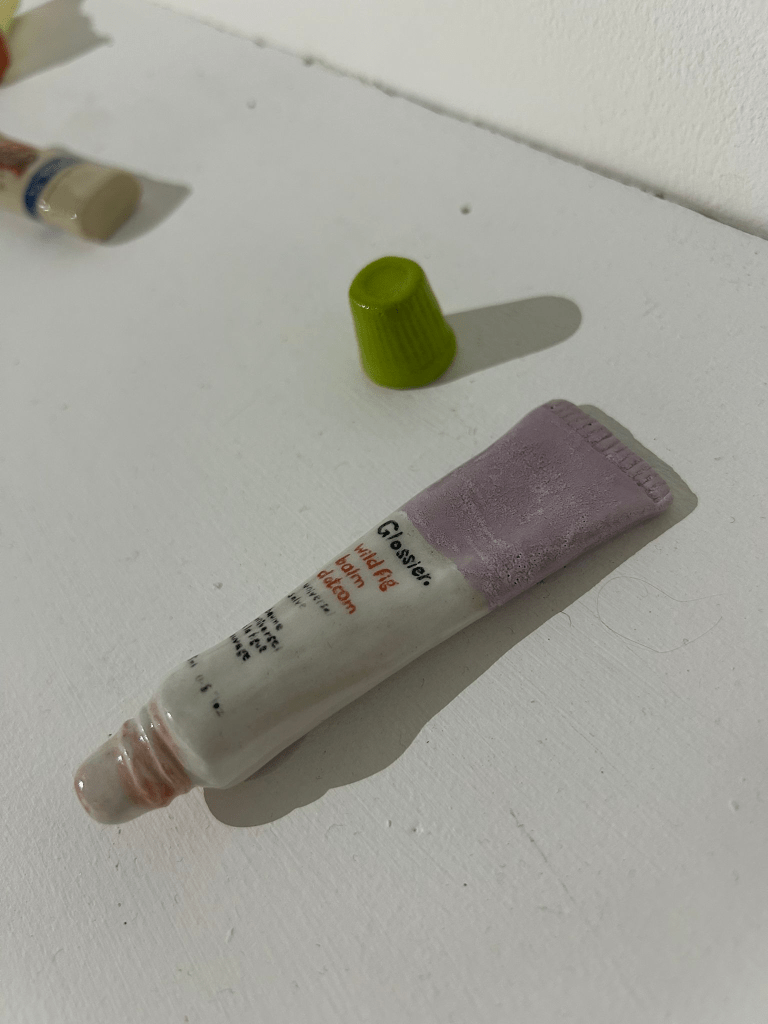
At the start of February we were invited by DJCAD’s Contemporary Art Society (CAPSoc) to facilitate a [synonym] session in early March for the then upcoming exhibition The Art of Human Connection, Generator Project, Dundee. It was an exhibition filled with Duncan of Jordanstone Contemporary Art & Design’s students and their works ranging from fleshy textiles to balm mimicking ceramics. The chosen works were displayed for their exploration into the diverse ways people experience connection through relationships, memories, landscapes, technology, and the body.
Colourless
Only faint but sometimes dark and intentional
Black lines

They curve but sometimes they create sad drooping swoops across the page. Some are never straight.

I see no straight lines.
The lines are thick, or thin, some are filled in, some are on their own, some cross, some blend together..

Carried across the page, the utensil is held softly with one gentle motion.
The lines could be more dragged, rather than with directional intent.

The smudge creates a shadow, it is this depth that gives the character its shape.

Though no colour there is distance, but the lines create the vocality.
Continuing from this descriptive prompt, we encouraged our writers to use internal visuals rather than the external – using their own memories. Our hopes with using personal memories are that they are a powerful and solely accessible tool to our practice in art making. To help them start we offered starting points to jog the reminiscing of internally logged spaces: thinking of place, colour, shapes, textures. Using these helps to build familiar environments, becoming an ephemeral architect constructing familiar scenes and the occasion(s) that captured that place in time. Using this exercise allows us to connect with ourselves, our bodies, our past, our environments (gone or remaining). Using the artworks from this first prompt as a jumping point to exercise our ability to connect and reconnect with distant places in real time is an exciting process in evaluating our personal experiences.
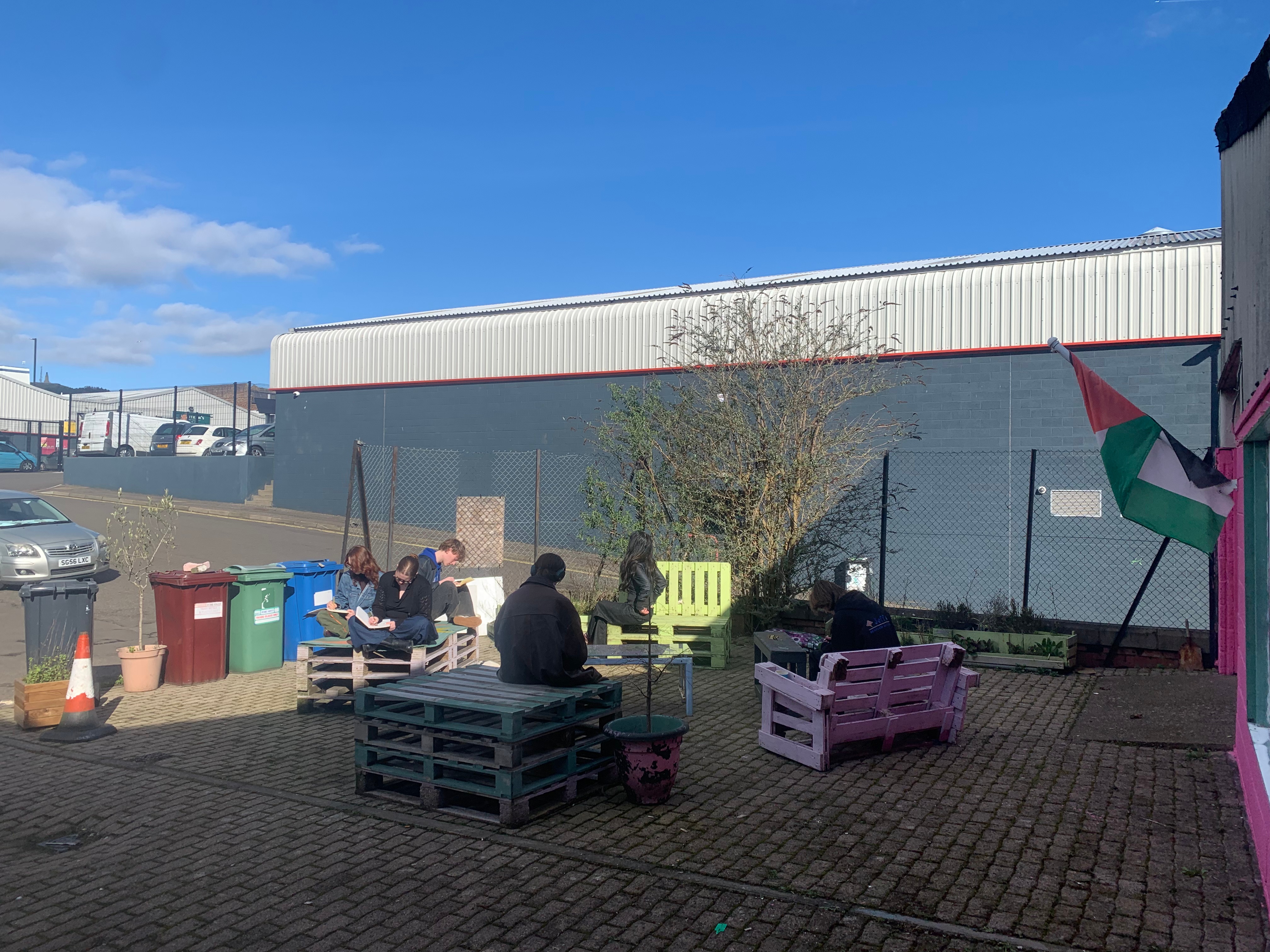
It was a great opportunity for the writers to use the outdoor space and the warm tendrils of the sun’s light to lull them into these meditative moments while simultaneously transforming memory into words.
The memory prompt allowed reconnecting to ourselves, but for the last prompt we wanted the writers to connect with art spaces through a Third Space lens. Partially because the students were already familiar with their peers and their artworks on display, but also because of the recent “breaking of arts” occurring throughout Scotland. The closure of glass making facilities in the highlands, the proposed closure of the Cooper Gallery in Dundee, and the abundance of cultural and community art spaces in Glasgow facing or having already faced closure.
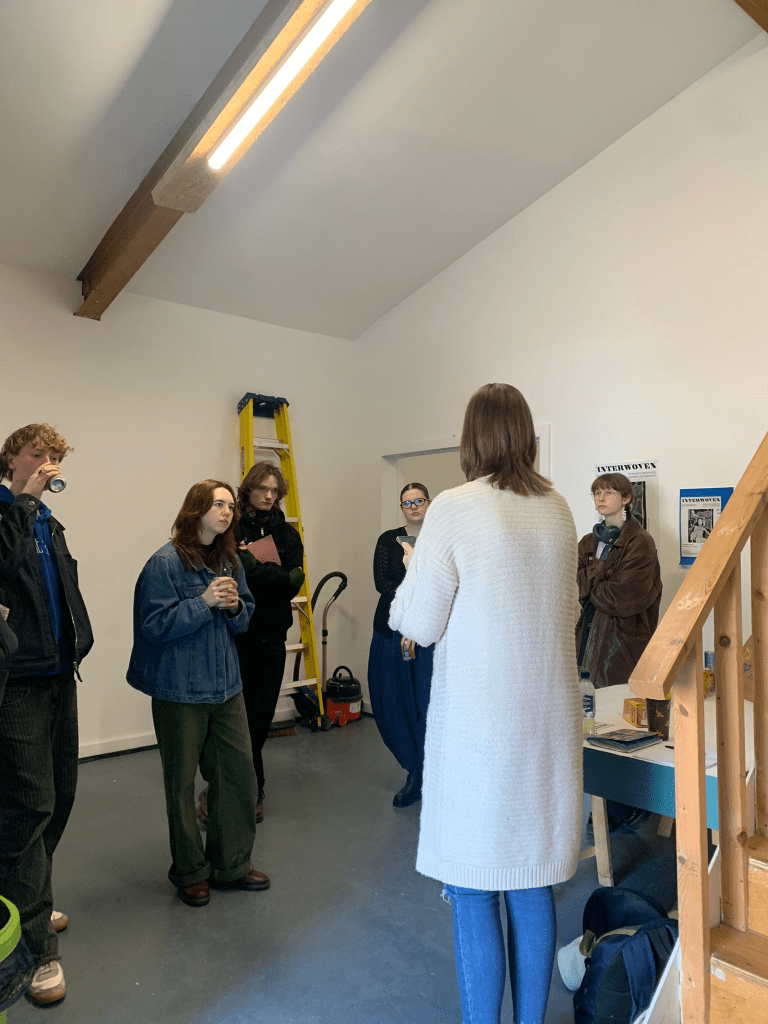
So, instead of writing we opted for this last part to be a space for discussion regarding these spaces, although not something we have done previously, we felt like it was an apt time to highlight the precariousness they face.
Being in a space like Generator Projects was a great environment to start this conversation as we spoke about the opportunities it provides for the DJCAD students and by extension the student association as well as plenty of other external creatives. We mentioned the current situations in Glasgow and the art spaces like Listen Gallery and Trongate 103, all crucial to creatives and artists but faced with closing pressures and instability. Listen Gallery is an unmatched space where so much opportunity is enabled and important conversations are had whether it’s through exhibitions or performances or gathering events, though without stable support they are running themselves into exhaustion in their valiant efforts to keep the nomad space open. And Trongate has been hit by an unforeseen force that wishes to evict the art charities and organisations from this creative cloud (petition is still available to sign if you haven’t already! Find link below). And, of course, the immediate closure and liquidation of the CCA which has dismantled not only creatives, but workers and independent businesses such as The Slow Chai whose passion-filled boxes sit in the corner gathering dust.
Through this discussion, collectively we highlighted the ongoing destruction of art spaces around the country and the frustration this brings as well as the understandable concern this creates for soon-to-be graduates leaving them to feel quite deflated. The arts and the right of expression are a vital course that runs through any community and within – the power of togetherness. Although times are tough, there is never a more important time to stand up and in solidarity for cultural workers, artists, creative spaces and our heritage which is being threatened.
Tomorrow (Friday 27th March) there will be a community protest to stop the closure of Trongate 103. This site, which houses many organisations, was served with a short notice of eviction if the tenants couldn’t cough up the astronomical rent hike. The sender being Glasgow’s City Property (an arms length branch of the City Council) will be responsible for the loss of the organisations within. Those organisations that are renowned nationally and internationally, those that work to preserve heritage arts, support vulnerable people through art making and support emerging artists and film makers. GMAC, Project Ability, Transmission Gallery, Glasgow Print Studio, Streetlevels Photoworks, Sharmanka Kinetic Theatre, Glasgow Independent Studio.
There is shock and uncertainty building up, watching those or experiencing the demand of rent increases in an industry squeezed of what little money there already is. Please sign the petition to save Trongate 103 and their tenants HERE.
We wanted to highlight the work being done by community members to raise up against this cultural decimation – follow Glasgow Cultural Conditions on Instagram (@cultureconditions) for community action for cultural spaces, with news of how to get involved, news on what is happening and well collated information with on the ground research.
A fundraiser has also been set up to support the staff of the CCA who lost their jobs overnight with no redundancy package HERE.
Another fund raiser is live to support the Listen Gallery with securing a new venue HERE.
If you can, please attend the meeting ‘City of Culture, Not City of Closure’ which is being held Thursday 9th April at The Boardwalk to discuss experiences, fair work, the future of cultural spaces and collective action – reserve place HERE
We would like to thank CAPSoc for inviting us to host this event, and we would like to thank the students for participating in the writing and contributing thoughts, feelings and questions to the important discussion at the end. Although the examples given are based in Glasgow, as artists we don’t live in isolation from each other and what is being implemented in Glasgow by GCC, Glasgow Life, creates an instability for the arts everywhere.
Their exhibition, The Art of Human Connection offered an incredible space to talk about these issues. At its core, it truly encapsulates art as a connection.
 Gal bag.