Saturday 23rd June, our visit to the Talbot Rice Gallery was on a day that was sunny and warm just like last year’s session there (we will be planning more here if the weather is going to be so nice!). Last time we explored the collaboration of human and non-human dialogue channeled through the language developed through Walker and Bromwich’s practice, this time we look into a inter/generational dialogue highlighted by four artists whose works are charged by community, familials, land, as well as the non-human.
The dead don’t go until we do explores stories gathered by artists Małgorzata Mirga-Tas, MADEYOULOOK, Kang Seung Lee, and Amol K Patil. Spread across the entire gallery space from the White Gallery (which was very blue), through the side gallery, upstairs to the Upper Galleries (one dim and dark; the other blindingly bright), the Georgian Gallery balcony (swathed in darkness again) to go back downstairs on to the ground floor segment of the Georgian Gallery. All spaces creating reconnective tissues that can be accessed by the viewers if they choose to follow the kinetic, haptic, optic, and acoustic narrators.
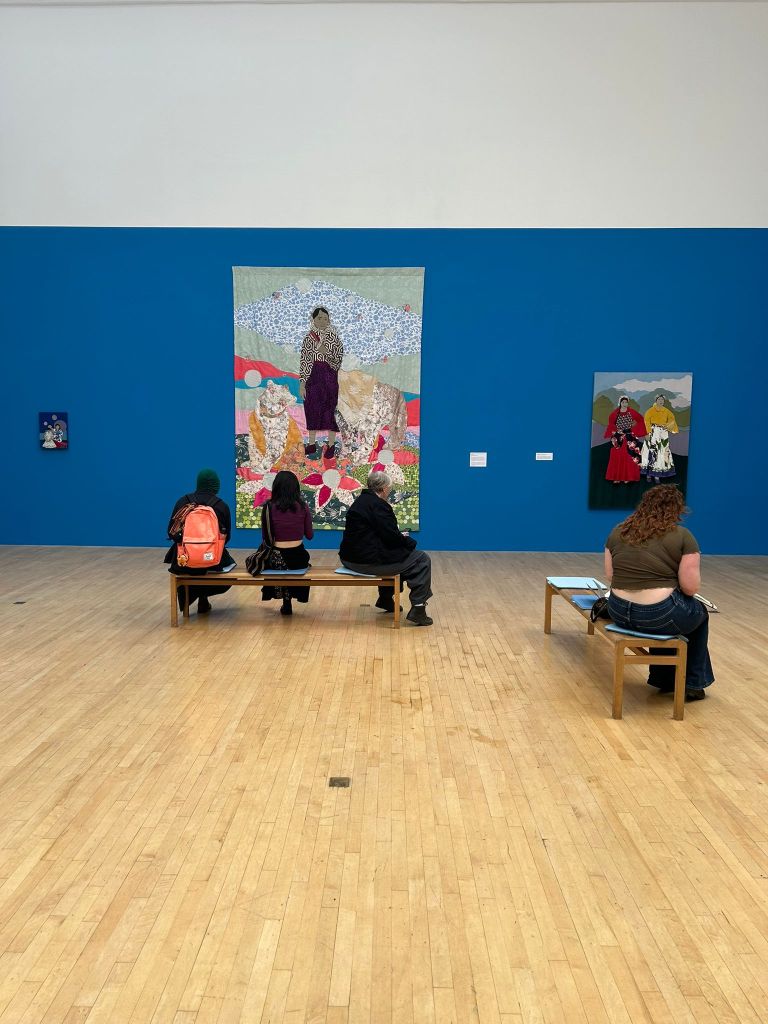
We began with the blue White Gallery which was home to the colourful work of artist and activist Małgorzata Mirga-Tas. There she redressed hundreds of years of persecution of the Roma community while simultaneously celebrating moments of everyday joy – holding close the strength of both past and present communities. Mirga-Tas aimed to “disenchant” the representations of the Roma people, moving away from exoticised or romanticised portrayals to foreground everyday realities. We won’t stay silent any longer was a political act of reclaiming visual history for a people whose image has been shaped by non-Roma artists and cultures.
Eliza, as a Highlander, was able to feel a relation to the dialogue Mirga-Tas was conveying, through the term ‘Highlandism’ and although it is a side note of interest by Eliza, as we know it isn’t a comparison but provides a historical connection between two places. This romanisation of a culture and of a people can be experienced through this term here in Scotland. It describes the cultural phenomenon—largely born in the eighteenth and nineteenth centuries—where elements of Highland life were rebranded into a nostalgic, as well as an aesthetic symbol of national identity. This ‘Highlandism’ erases the everyday struggles of people living in the Highlands as it was created to flatten the Highlands, physically with the ‘Highland Clearances’ but also as a modular area that can be depicted in films and poems. This imposed identity was heavily enforced by the Royal Family, particularly by King George IV and Queen Victoria, but did not account for the fact that most Scottish people at this time were impoverished and poor. Gaelic as a language was persecuted throughout this romantic era and with the final loss of the Jacobites in 1746 causing further damage to Gaelic, the British Government also banned everything related to Highland culture.
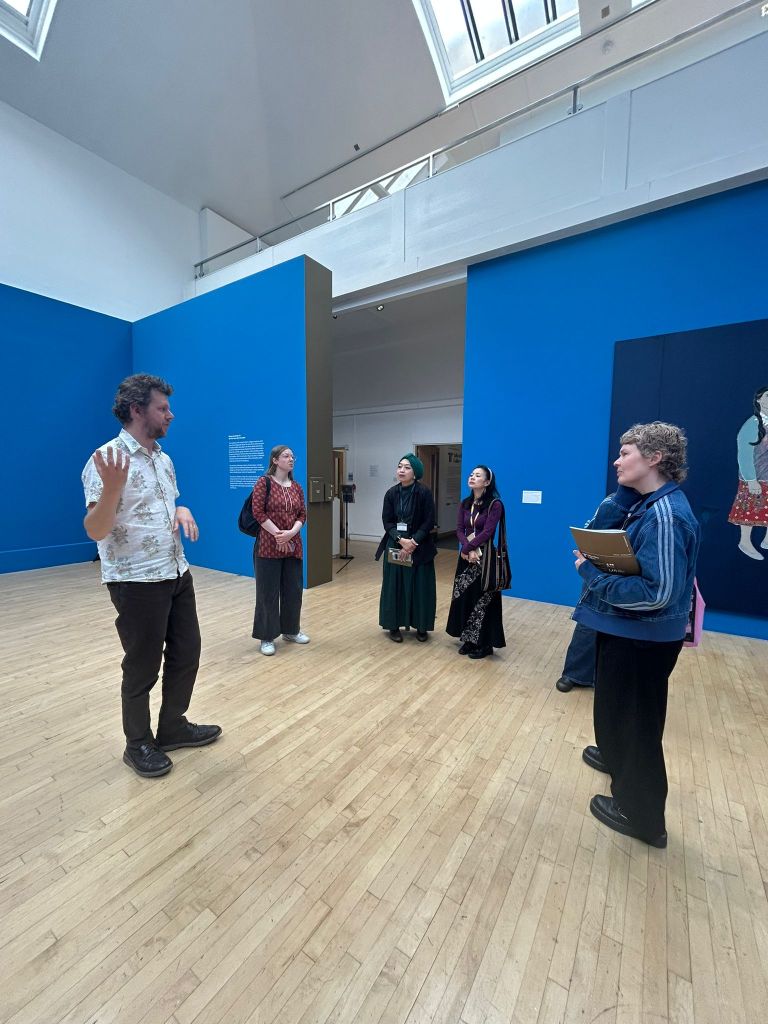
Through art we are able to hold and keep these spaces for these communities, we are able to archive the truth of the lived realities and throughout Mirga-Tas’ exhibition there are celebratory expressions of Romani culture told through a multitude of mediums in her large wall hung works, photography, and poems. The majority of works animating the walls were the large portraits depicted through colourful and patterned textiles which James Clegg, the exhibition’s curator, revealed were donated by the Roma community to the artist. This collaboration through community gave the works an authentic voice of not one person in the present but of many in tandem with the past voices highlighted in the works.
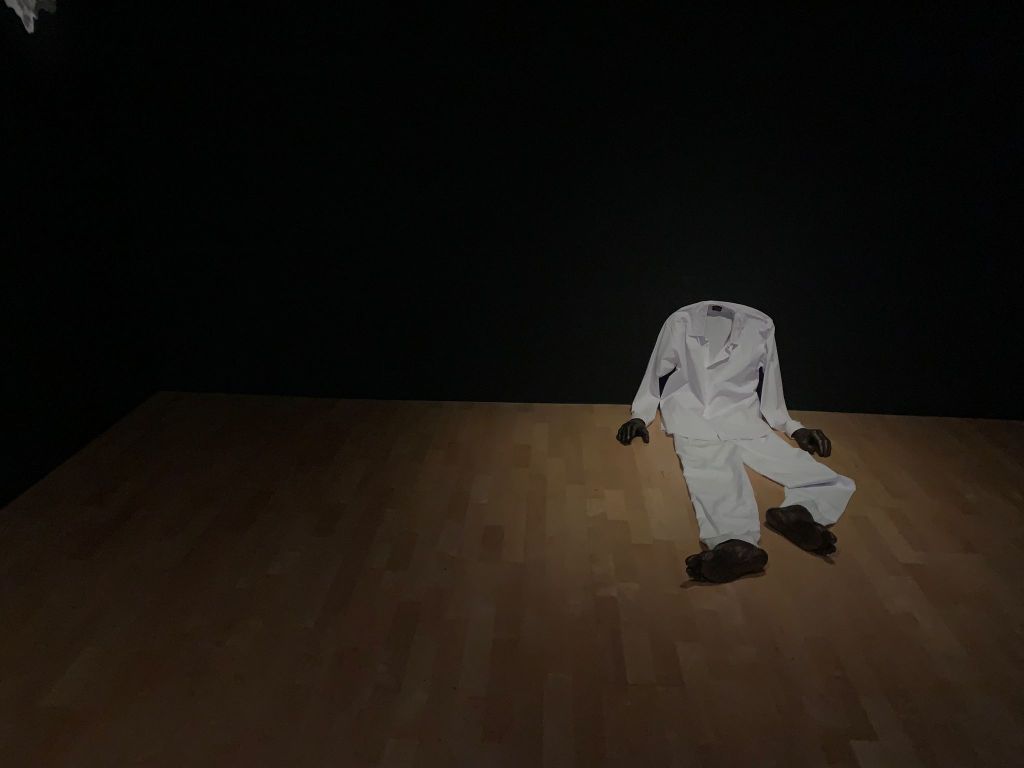
Having stared and pooled so many thoughts and feelings from Małgorzata’s work into our notebooks, we moved upstairs to view the work of performance activist Amol K Patil. Pairing his academic interests of memory and social structures with his performative practice, Patil highlighted our connections with nature and the dissonance between this and urban life. His film, poetry, and installations in Who is invited to the city? delineate the disconnection of the urbanisation of land and how this extraction has changed the shape of cultural practices sourced from his father’s research as a theatrical activist as well as from his grandfather’s writing.
The space itself being drenched in darkness with small warm glows to cut the objects out from the void is not only apt to his approach with his installations but to the direction he gave his film. The film documents the movement of villagers from their villages to cities in India. Patil describes the past movement as their search for “light” and “illumination”, tying it in with the Indian mythos of Hanuman. Hanuman was a monkey god who got so hungry he mistook the sun as a fruit and ate it, causing him suffering. The lightless room is in a way a recreation of the moment the hungry ape deity swallowed the light, purging the space into darkness – making the space an installation of this search for light in dark times.
‘Patil isolates passages that have more subtle resonance; when Dhasal writes, “There are neither flowers, Nor leaves; Neither trees, Nor birds”, he is commenting on how even the force of nature can no longer reach those lost to the city.’
Exhibition Guide page 14
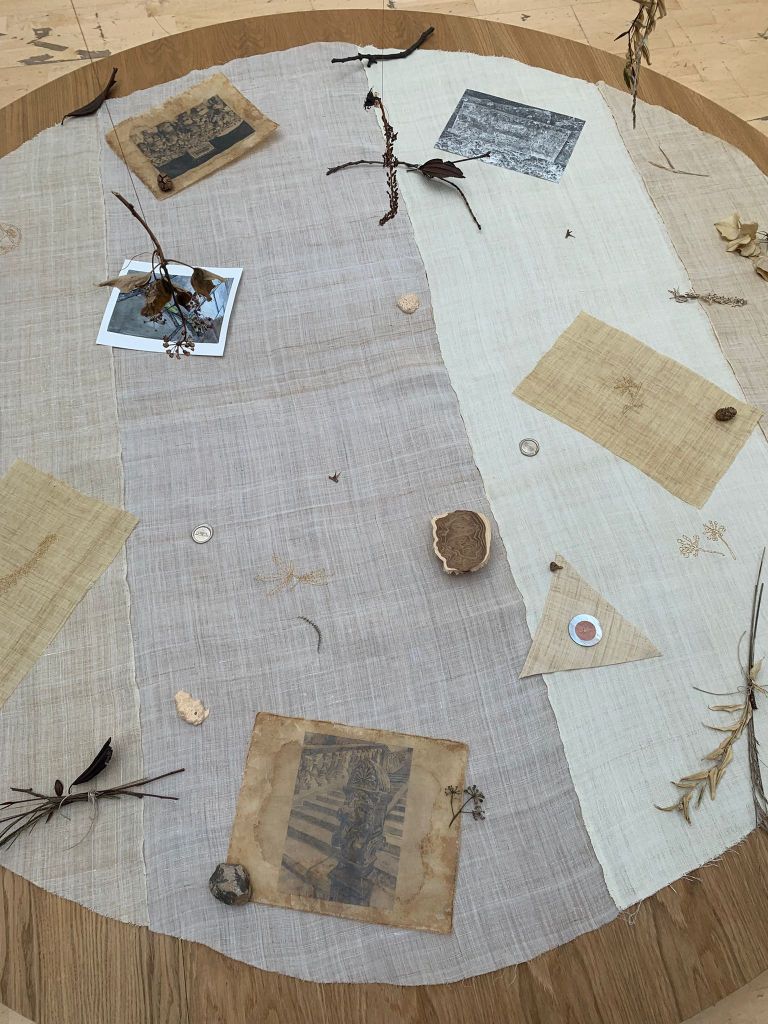
Moving from dark to light, we cross the White Gallery balcony and enter the Upper Gallery space. Through scorched retinas we were met with Kang Seung Lee’s installation. Erasure held like a fierce lantern was composed of images (framed and unframed) hung sparsely across the circular room’s walls and in the middle there was a suspended collection of feathers, sticks, textiles hovering above an elevated circle wooden “plinth” decorated with similar organic objects and unframed printed images. Lee’s work is drawn from archives, the collection exhibiting his findings reflect this method of information sourcing, utilising natural objects and images of sites he creates an animated archive on queer history. Sites are not only architectural but also of persons. Redrawing deceased queer artist’s drawings of queer-involved sites is an act of reconnecting as well as revitalising spaces that have been left behind in history books, giving them a revival of not only space but person. It’s like a living archive but rather a reliving archive.
Lee is interested in non-human beings that have existed longer than any of us, including plants that can remain dormant for long periods before flowering. As witnesses to the world around them, these forms resonate with queer histories, which Lee notes are “continually erased, rewritten and reasserted”.’
Exhibition Guide page 18
The Georgian Gallery, the exhibition’s last space in the exhibition tour welcomes us back into a dark environment with spotlit words and topographical sculptures. In this part of the Talbot Rice gallery, there is a strong connection with the more-than-human world in which we resonate with. Together duo artists Molemo Moiloa and Nare Mokgotho, or more collectively known, MADEYOULOOK, explore de-colonial relationships with the land, seeking new forms of knowledge connected to black everyday practice. With other artists referencing aspects of nature and culture as a key to working with understanding generational traumas of land, histories, as well as shared and reclaimed cultures; Mafolofolo asks us to have an embodied relationship with the words instead of approaching the work using the English language and lens. This way of experiencing is a decolonial approach to sharing a primary language as it is removed from inhibitive western perspectives. These structures, made by a people who experienced multiple cycles of land dispossession and reclamation (dated back to the sixteenth century), represent a unique ecological system.
“Today they appear like a gift carrying the knowledge of a different way of being within the land – The memory of these places now retained through oral histories.”
Exhibition Guide page 22
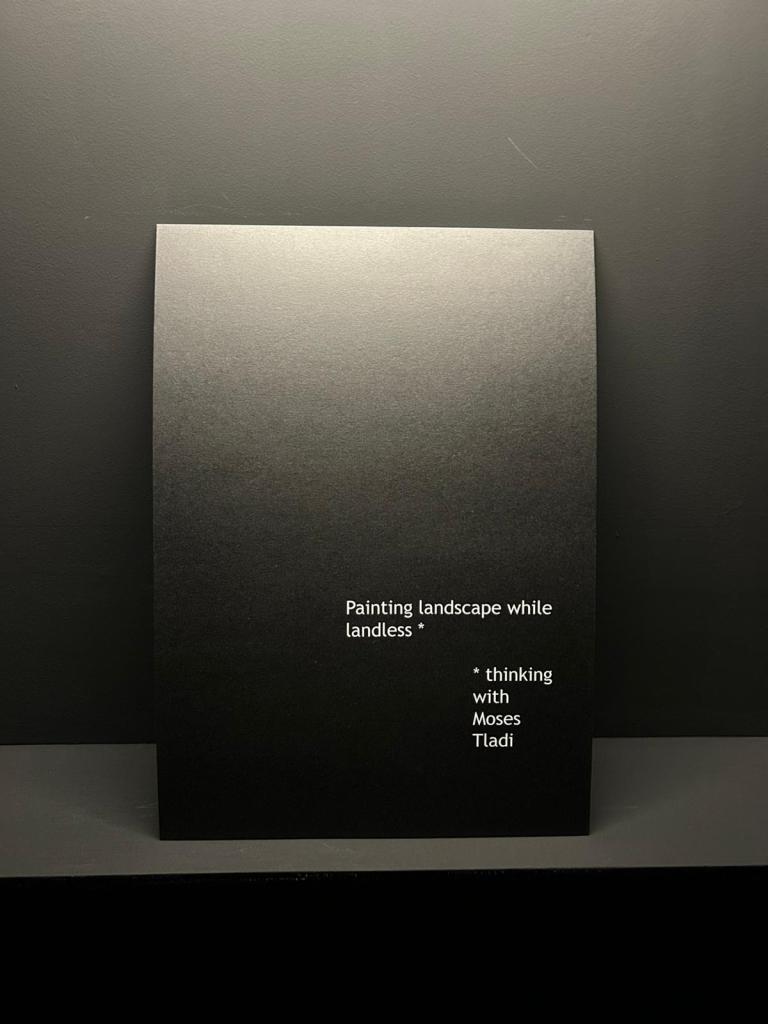
It was from this space and the chat with James Clegg that made us think of landscape paintings and why we never quite connected with them. It was the westerner perspective that we were stuck with rather than the landscape itself. These black landscapes were cropped leaving nothing to connect to – a removal of the intimacy of the land. No longer will we describe our thoughts on these sorts of landscape paintings as boring but rather they are disconnected, like the Highlandism example Eliza felt, it’s purely only a romanticisation of the site where no connection can be made.
With these dialogues were able to charge our creative writers with pretty dense prompts, encouraging them to engage with their inter/generational archives using on-site memory or enabling them to act on the thoughts they had brought with them into the space.
Thank you to the Talbot Rice Gallery team for inviting us back to host another one of these [synonym] sessions!
Also, a big thank you to James Clegg for talking to us and our writers about the exhibition – it was fantastic hearing about your stories with the artists involved.
And, of course, thank you to the writers who had joined us on this one. We were so pleased to hear the session and exhibition helped with the thoughts swimming around your minds before even entering the gallery.
We mention an Exhibition Guide, please find the link here to view it in deeper detail.
And, of course, Talbot Rice’s page for the exhibition can be found through this link here.

